

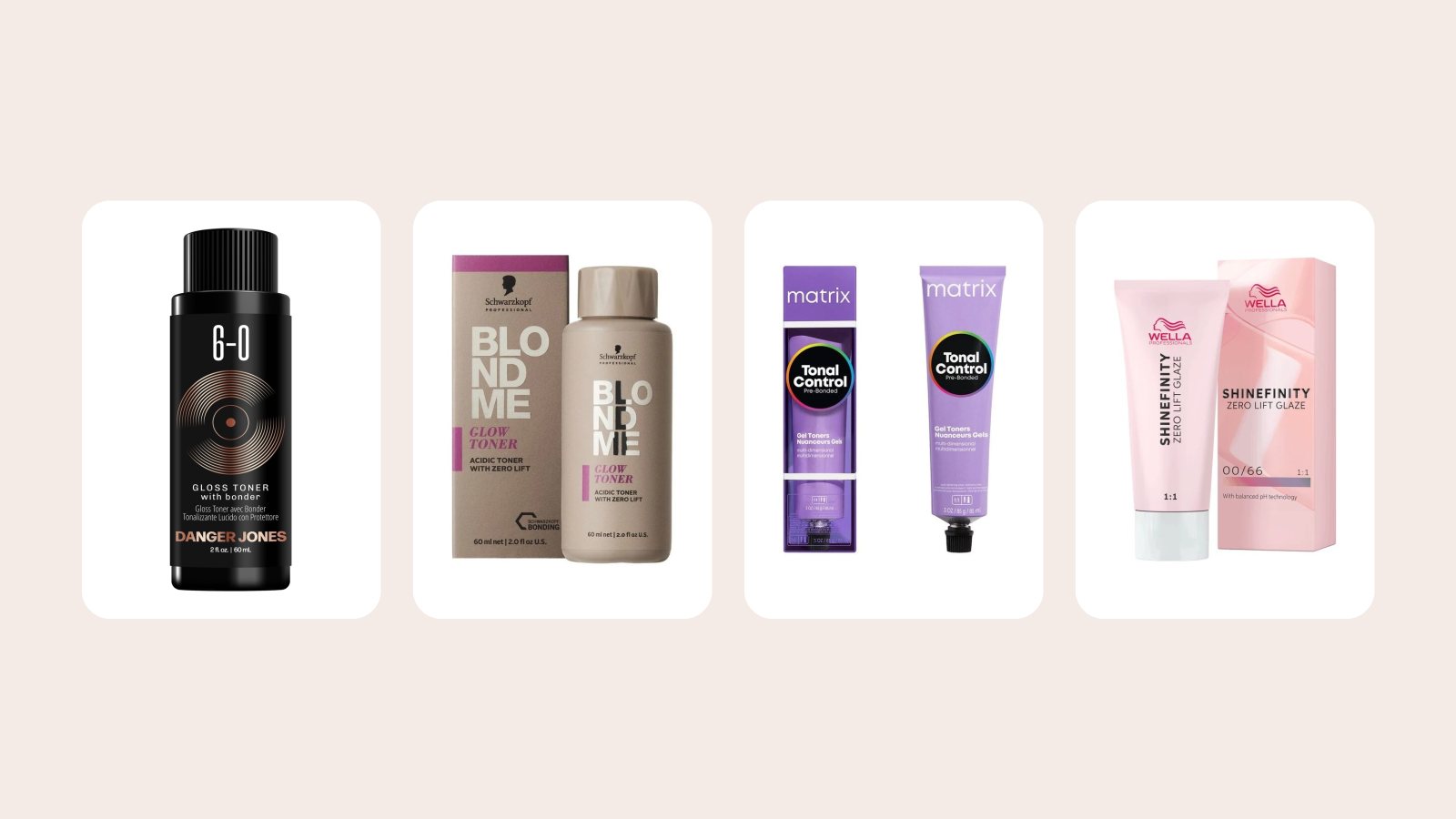
To tone hair after bleaching, lift the hair to the right level first, then apply a toner opposite the leftover warmth on the color wheel: violet for yellow, blue for orange. Mix it with the developer its maker names, at the maker’s ratio, and time it by the maker’s directions. Toner fine-tunes a lightened base; it can’t lighten it further.
Key takeaways
- Toner neutralizes and deposits tone. It does not lift, so the lightener does the lifting first.
- Violet cancels yellow; blue cancels orange. Choose by the color you see after rinsing the lightener.
- Acidic glosses work near the hair’s own pH with little cuticle swelling. Alkaline formulas swell the cuticle so more color can enter.
- Ratios, developers and times differ by brand. Use the developer the maker names and watch the hair, not just the clock.
- Toner is hair color: patch test 48 hours before every service, wear gloves, and never use it on brows or lashes.
What toner does after bleaching (and what it can’t do)
Matrix explains that the persulfates in lightener break up both eumelanin and pheomelanin, and that the brassy undertones in lightened hair come from pheomelanin. That leftover warmth is what toner handles.
Wella describes toner as a semi- or demi-permanent formula that perfects the final result, and says a toner won’t lift your shade; it fine-tunes it. It works through the color wheel. Wella’s color education explains that opposite colors cancel each other when mixed:
- Yellow or pale yellow: violet-based toner.
- Orange: blue-based toner. Wella notes that orange is the undertone of dark hair lifted to levels 5 to 7, and that a hint of violet also helps yellow-orange hair around level 7.
- Red: green-based correction.
Our guide to hair color levels and tones shows the warmth each level exposes.
Lift to the right level before you tone
Because toner only deposits, the lightened level decides what it can do. Wella’s guidance:
- For platinum, lift to a very pale yellow, around level 10, then tone away the remaining yellow.
- Its Blondor toner guide says to pre-lighten about half a shade lighter than the result you want.
- A deposit-only glaze such as Shinefinity doesn’t lift natural pigment, so the result depends on the starting base and can look darker than expected.
Toners are also built for set starting levels. Kenra makes its Rapid Toners for pre-lightened hair at levels 8 to 10, and Schwarzkopf lists its BLONDME Glow Toners for pre-lightened levels 7 to 10, depending on shade. Joico says its Level 12 Demi Gloss toners work best starting from the lightest pale yellow.
For the lift itself, Wella says BlondorPlex 9 lifts up to 9 levels, mixes 1:1.5 to 1:2 with Welloxon Perfect 1.9% to 12%, and develops for up to 50 minutes. Joico rates Blonde Life Powder Lightener at up to 9+ levels, and Matrix rates BlondeMax 9+ at up to 9. Our powder vs cream lightener article compares formats and on-scalp developer limits.
Acidic vs alkaline toners
The difference is pH, and pH changes how the cuticle behaves. Wella’s pH guide explains:
- Hair’s natural pH sits around 4.5 to 5.5.
- An alkaline product softens and swells the cuticle so color can enter. With an alkalizer such as ammonia, peroxide and oxidative dye precursors can get into the hair. Stylists typically choose alkaline color to lighten, cover gray or make a lasting change.
- An acidic pH draws the cuticle together into a smoother, glossier surface.
- Lightening moves hair to the alkaline side, and the right aftercare brings it back toward its normal pH.
Schwarzkopf says the acidic pH of its Glow Toner helps close the cuticle and hold pigment, which it calls especially useful after lightening, when the cuticle is open and hair is porous.
“Acidic” here means mildly acidic. Wella says Shinefinity stays no lower than pH 6.5 and warns that too low a pH can give unpredictable results on very porous hair. Danger Jones puts its Gloss Toners at an average pH of 6.7. It also makes alkaline Artistic Toners and says never to mix the two kinds.
Wella adds that a demi-permanent toner can give subtle lift with low-volume developer, while a glaze gives none. Some toners are permanent, such as Wella’s Blondor Permanent Liquid Toner, which Wella says won’t over-deposit. See permanent vs demi vs semi-permanent color for the families.
Developer, ratio and timing for the toners we carry
Here is what each maker’s directions say. “Not stated” means the maker’s page didn’t say; check the leaflet in the box.
| Toner | Type | Developer and ratio | Time | Damp or dry |
|---|---|---|---|---|
| Wella Shinefinity Zero Lift Glaze | Acidic demi glaze | 1:1 with Shinefinity Activator 2% | About 20 min (10 for a Speed Glaze) | Dry or towel-dried |
| Schwarzkopf BLONDME Glow Toner | Acidic demi | 1:1 with BLONDME Premium Developer 2% / 7 vol (Gel Developer for bottles) | 10 min, up to 20 | Not stated |
| Matrix Tonal Control Pre-Bonded | Acidic gel-cream | 1:1 with Matrix Cream Developer 10 vol (3%) | 20 min, room temperature | Clean, dry or damp |
| Danger Jones Gloss Toner | Acidic liquid demi | 1:1 with Gloss Toner Developer only | 3–10 min, room temperature | Damp or dry |
| Joico Blonde Life Demi Gloss | Ammonia-free demi | 1:1 with Joico 5 volume developer | Up to 20 min, room temperature | Not stated |
| Kenra Color Rapid Toner | Ammonia-free demi | 1:2 with Kenra Color 9 Volume Activator | 5 min or less | Shampooed, conditioned, towel-dried |
| Goldwell Colorance Gloss Tones | Ammonia-free demi | 2% System Developer Lotion (ratio not stated) | 10 min | Not stated |
| Wella BlondorPlex Permanent Cream Toner | Permanent cream | 1:2 with Welloxon Perfect 1.9% Pastel; 3% (10 vol) to also break the base | 5 min | Damp |
| Wella Blondor Permanent Liquid Toner | Permanent liquid | 1:2 with Welloxon Perfect 6 or 20 vol | Up to 10 min pastel, 30 min base toning; no heat | Towel-dried, after shampoo and conditioner |
- Watch the hair. Wella says to check Blondor toners often, Schwarzkopf says to always allow for visual control, Matrix made Tonal Control deepen visibly as it oxidizes so you can see when to rinse, and Joico says to process until the tone is reached, up to 20 minutes.
- Never go past the maximum. The FDA advises never leaving hair dye on longer than directed and using a timer.
- Use the maker’s developer. Danger Jones says its Gloss Toners work only with their own developer, and to dilute with its 0-0 Clear rather than extra developer. Our developer volume guide explains low-volume activators.
Damp or dry, and porous ends
Follow the table. Wella adds that with Shinefinity, towel-dried hair and shorter times give softer results. Porous ends can grab toner and go too dark. Joico suggests its Level 12 toners for extremely porous ends and warns that diluting with Clear on the blondest porous hair can turn too dark or off-tone. Matrix suggests lightly misting its porosity product on overly porous mids and ends before Tonal Control.
Step by step: a toning service after lightener
- Patch test 48 hours before. The FDA says to patch test every time before dyeing hair, and Wella’s BlondorPlex toner directions call for an allergy test 48 hours before each application. Danger Jones notes that some Gloss Toner shades contain PPD and resorcinol. See our 48-hour patch test guide.
- Lift, rinse and look. Read the color in good light: yellow or orange? Check the scalp too; the FDA says not to dye hair when the scalp is irritated, sunburned or damaged.
- Prep as the toner asks: shampooed and towel-dried, damp, or dry (see the table).
- Glove up and measure. The FDA says to wear gloves when applying hair dye. Measure toner and developer at the maker’s ratio.
- Apply evenly and start a timer. Keep toner away from the eyes; the FDA says never to dye eyebrows or eyelashes, which can hurt the eyes and may cause blindness.
- Rinse the way the maker says. Danger Jones says to shampoo its oxidative Gloss Toners out. Schwarzkopf says the Glow Toner needs only a thorough rinse. Joico follows its Demi Gloss with a Blonde Life shampoo and masque.
Same day or wait? Sources differ. Salon toners are made for freshly lightened hair: Wella calls BlondorPlex Cream Toner an express toner for all lightening services, and Schwarzkopf pitches its Glow Toner for hair right after lightening. The FDA’s consumer checklist, however, says to wait at least 14 days after bleaching, relaxing or perming before using hair dye. In the salon, follow the toner maker and your read of the hair and scalp. At home, follow the FDA.
Between visits: toning shampoo and conditioner
Pigmented care maintains tone but deposits far less than a toner. Our purple vs blue shampoo guide covers which clients need which.
- Purple shampoo: Pravana says to leave Perfect Blonde Shampoo on 2 to 3 minutes, or 5 to 7 for stronger toning. Wella says to rinse purple shampoo out after five minutes at most, and not to use it on dry hair, which is more porous and can turn patchy.
- Purple conditioner or spray: Matrix says to use a quarter-size amount of So Silver Purple Conditioner after shampoo, for up to 3 minutes. Schwarzkopf’s BLONDME Purple Spray Conditioner is a leave-in that it says neutralizes yellow and detangles.
- Blue for lightened brunettes: Joico says Color Balance Blue Conditioner neutralizes orange, brassy tones in brunette hair; leave it on 1 to 3 minutes, 2 to 3 times a week.
When toner fades, and how to make it last
Most toners are demi-permanent and wash out gradually. Matrix says Tonal Control lasts up to 24 washes, and Wella says Shinefinity can last up to 6 weeks without harsh grow-out lines. Wella calls every 4 to 8 weeks the most common interval for toning, or 8 to 12 weeks for lower maintenance.
Wella names water exposure as one of the most common causes of fading toner, and says few things bring out brass faster than hot tools, so use a heat protectant. It also suggests alternating toning care with a gentle shampoo for color-treated hair. More habits are in how to keep hair color from fading.
At OBB
- Acidic toners: Wella Shinefinity Zero Lift Glaze with Shinefinity Activator, Brush & Bowl 2% (Wella says both activators are the same strength, differing only in consistency), Schwarzkopf BLONDME Glow Toner, Matrix Tonal Control and Danger Jones Gloss Toner.
- Ammonia-free demi toners, per the makers: Kenra Rapid Toner, Joico Blonde Life Demi Gloss and Goldwell Colorance Gloss Tones.
- Wella permanent toners: BlondorPlex Permanent Cream Toner and Blondor Permanent Liquid Toner.
- Lighteners: Wella BlondorPlex 9, Joico Blonde Life Powder Lightener and Matrix BlondeMax 9+.
- Between visits: Pravana Perfect Blonde Shampoo, Matrix So Silver Purple Conditioner, BLONDME Purple Spray Conditioner and Joico Color Balance Blue Conditioner.
Call or text (949) 591-5304 with your list and we will confirm stock and pricing, then pick up at our Westminster store.
Related reading: purple vs blue shampoo, hair color levels and tones, powder vs cream lightener and the developer volume guide.
FAQ
Does toner lighten hair?
No. Wella says a toner won’t lift your shade; it fine-tunes it. Lightening is the lightener’s job.
What toner cancels orange?
A blue-based toner, because blue sits opposite orange on the color wheel. Yellow needs violet.
Do you apply toner to wet or dry hair?
Whatever the maker says: damp for BlondorPlex Cream Toner, towel-dried for Kenra Rapid Toners, damp or dry for Tonal Control and Danger Jones.
How long should toner stay on?
From 3 to 30 minutes, depending on the product: Kenra Rapid Toners 5 minutes or less, BLONDME Glow Toner 10 to 20, Blondor Liquid Toner up to 30 for base toning. Never go past the maker’s maximum.
Why did my toner fade so fast?
Demi toners wash out gradually, and Wella names water exposure and hot tools as common causes. Wash less, use heat protectant, and add toning care between visits.
Sources
- U.S. Food and Drug Administration, Hair Dyes (content current as of September 2025)
- Wella Professionals, Does toner damage hair?
- Wella Professionals, Hair color charts: the lightening curve and color wheel
- Wella Professionals, How to tone orange hair
- Wella Professionals, Why pH matters (Shinefinity pH guide, PDF)
- Wella Professionals, Color Touch vs Shinefinity Zero Lift Glaze
- Wella Professionals, Shinefinity Zero Lift Glaze and Shinefinity top tips
- Wella Professionals, BlondorPlex Permanent Cream Toner, Blondor Permanent Liquid Toner and Blondor Permanent Liquid Toners tech guide (PDF)
- Wella Professionals, BlondorPlex 9
- Wella Professionals, Purple shampoo guide
- Schwarzkopf Professional, BLONDME Glow Toners, BLONDME technical booklet (PDF) and BLONDME Purple Spray Conditioner
- Matrix, Tonal Control Pre-Bonded, BlondeMax 9+ Lightener and So Silver Purple Conditioner
- Danger Jones, Gloss Toners with Bonder
- Joico, Blonde Life Demi Gloss, lighteners comparison and Color Balance Blue Conditioner
- Kenra Professional, Kenra Color Rapid Toners and SV Rapid Toner
- Goldwell, Colorance Gloss Tones
- Pravana, Perfect Blonde Shampoo
This article is general information for licensed stylists and color clients. The directions in the package come first. If the skin or scalp itches, burns or swells during or after a color service, rinse, stop and see a doctor.