

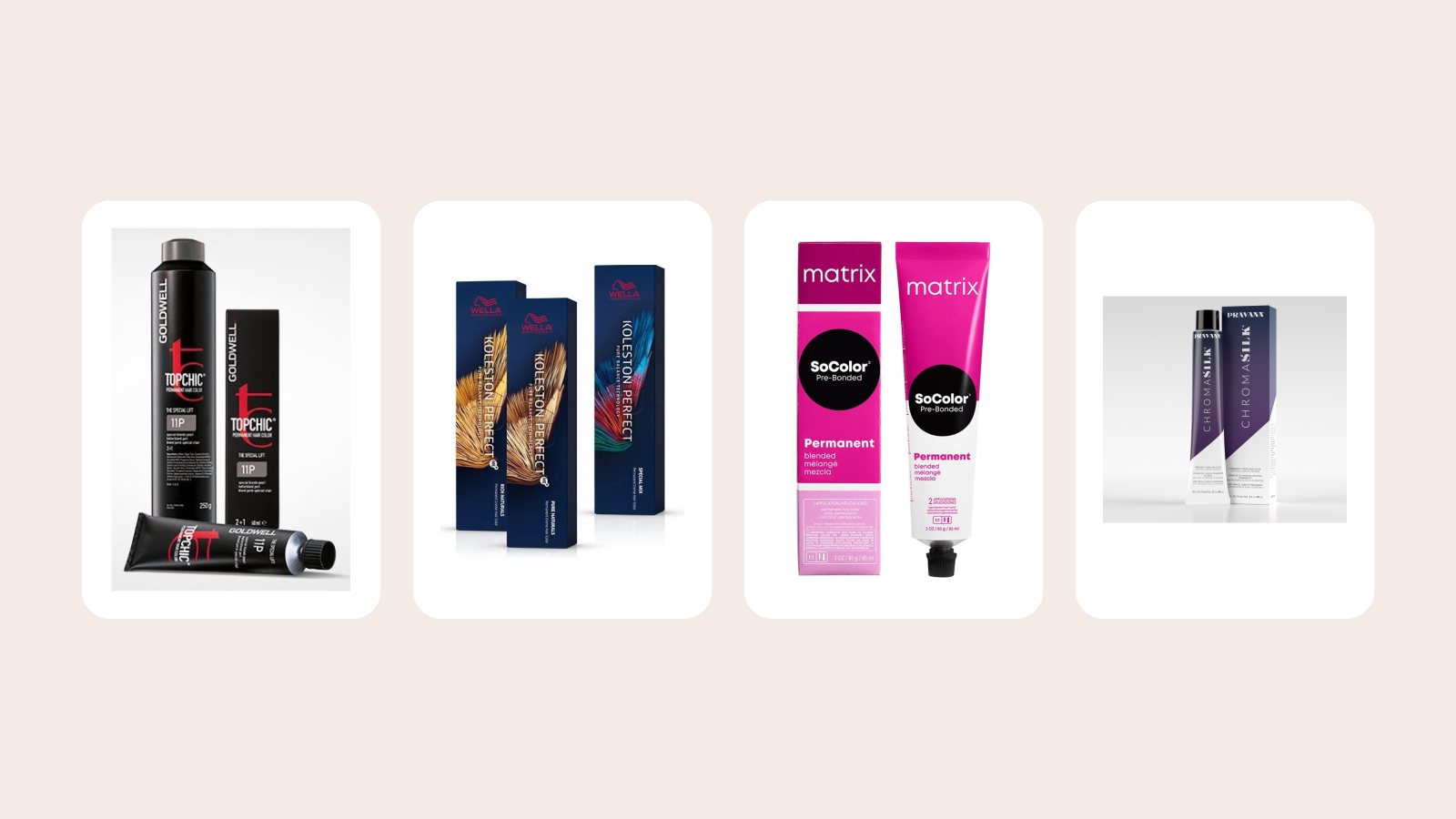
Most permanent hair color lines mix 1 part color to 1 part developer, but not all: Pravana ChromaSilk and Rusk Deepshine call for 1:1.5, Framesi Framcolor 2001 calls for 1:2, and most high-lift series use 1:2. Follow the brand in your bowl, not the one you used on the last client. Below are the hair color mixing ratios for the permanent lines we carry, taken from each maker’s own guide, plus how to measure and what to do with leftovers.
Key takeaways
- A ratio is parts of color to parts of developer. At 1:1.5, 40 g of color takes 60 g of developer.
- Most lines in the chart mix 1:1. Pravana ChromaSilk and Rusk Deepshine mix 1:1.5, and Framesi Framcolor 2001 mixes 1:2.
- High-lift series usually switch to 1:2 with a stronger developer, so check the series, not just the brand.
- Weigh color and developer, mix right before you apply, and throw away what is left.
- The FDA says to do a patch test before every color service, wear gloves, and never dye eyebrows or eyelashes.
What does a hair color mixing ratio mean?
The first number is the color, the second is the developer.
- 1:1 is equal parts. Wella’s Koleston Perfect fact sheet: 60 g of color with 60 ml of Welloxon Perfect.
- 1:1.5 is one and a half parts developer. Rusk: 1 oz (30 ml) of Deepshine color with 1.5 oz (45 ml) of developer.
- 1:2 is twice as much developer. Framesi: 30 cc (1 oz) of Framcolor 2001 with 60 cc (2 oz) of developer.
Developer volume (10, 20, 30 or 40) is a separate choice about peroxide strength and lift; see our developer volume guide.
Why the mixing ratio matters
Goldwell explains that Topchic needs 1:1 mixing with its Cream Developer Lotion “to create the ideal color mass, the correct pH value and mild alkalinity” so the color reaches the planned lightness and deposit. Change the ratio and you change that balance.
Lift and developer strength
Each brand ties lift to its own developer, and the numbers differ. CHI’s Ionic sheet says 20 volume lifts up to 1 level and 40 volume up to 3. Rusk says its 20 volume lifts up to two levels and 40 volume up to four. So one line’s lift chart does not carry over to another. To read the numbers on the tube, see hair color levels and tones.
Deposit
Developer also dilutes the dye. Framesi says that on porous, pre-lightened hair you may drop from 1:2 to 1:1 or 1:1.5 “for maximum pigment deposition”. Rusk lists 1:2 for “demi like results”, and Danger Jones says Epilogue mixed 1:2 with 5 volume works like a demi while keeping an alkaline pH. Extra developer means a sheerer result than the chart promises.
Gray coverage
Several brands name one ratio and developer for gray. Matrix mixes SoColor Extra Coverage shades 1:1 with 20 volume, CHI says Ionic Coverage Plus is always mixed with 20 volume, and Pravana uses 1.5 parts 20 volume for 45 minutes. For stubborn gray, see how to cover resistant gray hair.
Hair color mixing ratio chart by brand
We read every row on the brand’s own page, instruction sheet or education guide on October 6, 2026 (see Sources). Directions change, and Wella’s US store notes that when the website and the package differ, follow the label on the product. Always check the sheet in the box.
| Color line | Ratio (color : developer) | Developer the brand names | Processing time (per brand) | High-lift and special series | Source |
|---|---|---|---|---|---|
| Goldwell Topchic (2–10 series) | 1:1 | Topchic Cream Developer Lotion 3%, 6%, 9%, 12% (10–40 vol); 6% (20 vol) for gray | 30 min; 20 min with heat | The Special Lift (11- and 12-series): 1:2 with 9% or 12%, 45 min (30 min with heat) | Goldwell guide |
| Wella Koleston Perfect ME+ | 1:1 | Welloxon Perfect 6% (gray, 1 level), 9% (2 levels), 12% (3 levels); fact sheet also lists 4% | 30–40 min; 15–20 min with heat | Special Blondes: 1:2 with 9% or 12%, 50–60 min (25–35 min with heat) | Wella fact sheet |
| Wella Illumina Color | 1:1 | Welloxon Perfect 1.9%, 3%, 6%, 9% or 12% | 30–40 min; 15–25 min with a Climazon | None listed | Wella US |
| Matrix SoColor Pre-Bonded | 1:1 | Matrix Cream Developer 10, 20, 30 or 40 vol; Extra Coverage shades with 20 vol | 30–45 min | Ultra Blonde: 1:2 with 30 or 40 vol, 50 min | Matrix chart |
| Schwarzkopf IGORA ROYAL | 1:1 | IGORA ROYAL Oil Developer 3%, 6%, 9% or 12% | 30–45 min | Special Blonde (12- series): 1:2 with 9% or 12%, 30–45 min. Ultra Blonde (10- series) stays 1:1 | IGORA wall chart |
| Joico LumiShine Repair+ Permanent Crème | 1:1 | LumiShine Developer 10, 20, 30 or 40 vol | 35 min; up to 45 min for gray; no heat | None listed | Joico fact sheet |
| Paul Mitchell the color | 1:1 | Paul Mitchell Cream or Clear Developer | 35 min | Highlifts: 1:2 with 40 vol for maximum lift, or 1:1 with 40 vol for a more toned result; 45 min | PM education |
| Paul Mitchell the color XG | 1:1 | Paul Mitchell Cream Developer 10–40 vol; Ultra Toners with 10 vol | Depends on the developer volume; see the brand’s chart | Highlifts: 1:2 with 40 vol; 1:2.5 for resistant hair | PM education |
| Pravana ChromaSilk Creme Hair Color | 1:1.5 | ChromaSilk Creme Developer 10, 20, 30 or 40 vol | 30 min with 10 or 20 vol; 45 min, no heat, with 30 or 40 vol or with 20 vol for gray | Hi Lifts: 1:1.5 with 30 or 40 vol, 45 min | Pravana FAQ |
| Kenra Color Permanent | 1:1 | Kenra Color Permanent Coloring Creme Developer 10–40 vol | 30 min; up to 40 min for gray | None listed | Kenra |
| CHI Ionic Permanent Shine | 1:1 | CHI Developer 10, 20, 30 or 40 vol; Coverage Plus series always 20 vol | 30 min at room temperature; Coverage Plus 35 min | None listed | CHI sheet |
| Framesi Framcolor 2001 | 1:2 | Framesi Professional Activator 10–40 vol (Ossidorr needs an extra 10 cc) | 35–45 min; 50 min with 40 vol; no heat recommended | On pre-lightened hair, 1:1 or 1:1.5 is allowed for more deposit | Framesi manual |
| Moroccanoil Color Rhapsody | 1:1 | Moroccanoil Oxidative Cream Developer 5, 10, 20, 30 or 40 vol | 30–45 min; 15–25 min with heat | Ultimates: also 1:1, 35 min, up to 45 min for resistant hair | Moroccanoil |
| Danger Jones Epilogue | 1:1 | Danger Jones Deluxe Cream Developer 5–40 vol | 35 min at room temperature (FAQ: 35–45 min) | High Lift Colors: 1:2 with 20–40 vol, 45–55 min | Danger Jones |
| Rusk Deepshine Permanent (Pure Pigments) | 1:1.5 (Rusk also allows 1:2 for demi-like results) | Deepshine Shine Enhancing Cream Developer 10–40 vol; 10 or 20 vol for gray | Up to 45 min, no heat | Ultimate Blonde High-Lift: 1:2 with 30 or 40 vol, up to 45 min | Rusk |
| #mydentity Permanent | 1:1 | #mydentity Permanent Crème Developer 10–40V | 30 min; up to 40 min for gray | None listed | #mydentity |
“None listed” means the page we used gives no separate high-lift ratio. Ten-minute express lines have their own ratios; see our 10-minute hair color comparison.
Every brand names its own developer; Kenra, for example, says its permanent developers were “specially formulated” for Kenra Color Permanent. High-lift shades almost always move to 1:2 with 30 or 40 volume. And some series do not mix with the rest of the line: Matrix says to mix Ultra Blonde shades only with each other, and Pravana says its Hi Lifts are not compatible with ChromaSilk Creme Hair Color.
Weighing vs eyeballing: how to measure color and developer
#mydentity’s education manual says to weigh the color formulation “to achieve the most accurate mixing ratio”. Goldwell says to use proper measuring and mixing tools and to start with the developer lotion. Framesi marks each Framcolor 2001 tube in 10 cc steps and measures developer in a beaker.
- Use a non-metallic bowl. Kenra, Moroccanoil and Danger Jones say non-metallic, and Wella’s developer warning rules out a metal bowl or stirrer.
- Zero the scale with the bowl on it, then weigh the color.
- Add developer to the ratio: 30 g of color takes 30 g at 1:1, 45 g at 1:1.5 or 60 g at 1:2.
- Mix until smooth. CHI says to use its color whisk for proper mixing. For a bottle, Joico says developer first, then color, and shake well.
- Write the formula down with grams, developer volume and time.
What happens when the ratio is off
- Too much developer: the dye is diluted. Framesi and Rusk add developer only when they want less deposit.
- Too little product or time: Goldwell lists processing that was too short, or not enough product, among the causes of poor gray coverage, and the wrong developer lotion among the causes of color that fades too fast.
- Mixed-up series: IGORA’s wall chart says to ensure the correct mixing ratio and observe accurate development time. A high-lift shade mixed 1:1 is not the formula the brand tested.
Timing matters too. Wella’s Welloxon Perfect warning says not to exceed the stated development time, and the FDA says not to leave hair dye on longer than the directions say and to use a clock or timer.
Mix right before use, then throw leftovers away
Moroccanoil says to use Color Rhapsody “immediately after mixing”. Wella’s Welloxon Perfect directions say to use the mixture immediately and discard any unused mixture, and not to leave it in a closed applicator bottle, which may expand or burst. Mix only what the step needs, never cap mixed color for later, and recap developer right away; Wella says to keep developer away from heat and light.
Safety on every color service
The FDA’s hair dye checklist says to follow all label directions, do a patch test every time before dyeing, wear gloves, and never dye eyebrows or eyelashes, because this can hurt the eyes and may even cause blindness. Wella and CHI direct an allergy test 48 hours before each color service, and CHI notes that allergies can appear even in clients who have colored for years. Our 48-hour patch test guide walks through the steps.
At OBB
- Wella Professionals Koleston Perfect ME+ Pure Naturals: Wella mixes it 1:1 with Welloxon Perfect.
- Goldwell Topchic Permanent Hair Color: 1:1; Goldwell recommends 6% (20 vol) for gray.
- Pravana ChromaSilk Permanent Creme Hair Color: a 1:1.5 line, with ChromaSilk Creme Developer.
- Framesi Framcolor 2001 Hair Coloring Cream: Framesi’s standard is 1:2.
- CHI Ionic Permanent Shine Hair Color: 1:1 with CHI Developer.
- CHI 20 Volume Developer and CHI 40 Volume Developer: CHI’s Ionic sheet lists up to 1 and up to 3 levels of lift.
- Colortrak Pro Pack: feather bristle brushes, carbon fiber combs and croc clips, per Colortrak.
- Framar 3-Piece Classic Color Brush Set (Matte): Framar calls it a multipurpose brush, sold as a 3-pack.
Call or text (949) 591-5304 with your list and we will confirm stock and pricing, then pick up at our Westminster store.
Related reading: developer volume guide, hair color levels and tones, covering resistant gray hair and 10-minute hair color.
FAQ
Is permanent hair color always mixed 1:1?
No. Most lines in our chart are 1:1, but Pravana ChromaSilk and Rusk Deepshine use 1:1.5, Framesi Framcolor 2001 uses 1:2, and many high-lift series use 1:2.
Can I use another brand’s developer?
Each brand’s directions name its own developer, and the ratios and times above were written for that pairing. Stay with the developer the brand names.
Should I weigh hair color or go by the tube marks?
Weigh it when you can. #mydentity says to weigh the formulation for the most accurate ratio, and Goldwell says to use proper measuring tools.
Can I save leftover mixed color?
No. Wella says to use the mixture immediately and discard any unused mixture, and warns that a closed bottle of mixture may expand or burst.
Does more developer mean more lift?
Not on its own. Brands link lift to developer volume and high-lift shades; Framesi and Rusk show that extra developer on regular shades mainly gives a sheerer deposit.
Sources
- U.S. Food and Drug Administration, Hair Dyes (content current as of September 2025)
- Goldwell, All About Color, USA version (March 2020), chapter 7: Topchic
- Wella Professionals, Koleston Perfect fact sheet, Koleston Perfect 8/71 product page, Koleston Perfect 12/0 Special Blonde product page, Illumina Color: facts, formulas and new shades and Welloxon Perfect Crème Developer 20 Volume (warnings)
- Matrix, SoColor Pre-Bonded shade chart
- Schwarzkopf Professional, IGORA Color System wall chart
- Joico, LumiShine Natural Warm Series fact sheet (Repair+ Permanent Crème Color mixing and timing)
- Paul Mitchell, the color product knowledge course and the color XG product knowledge course
- Pravana, FAQ: ChromaSilk Creme Hair Color and Hi Lifts
- Kenra Professional, Kenra Color Permanent 10N product page (mixing instructions)
- CHI, CHI Ionic Permanent Shine instruction sheet
- Framesi, Framcolor 2001 technical manual (2020)
- Moroccanoil Professionals, Color Rhapsody Permanent Cream Color and Color Rhapsody Ultimates
- Danger Jones, Epilogue permanent color: mixing instructions and FAQ
- RUSK, Deepshine Permanent: usage charts and developer guide
- #mydentity, Permanent Haircolor and Education Manual (2023)
- Colortrak, Pro Pack; Framar, Classic Color Brush Set (Matte)
This article is general information for licensed hair professionals, based on brand directions read on October 6, 2026. Directions change, and the instruction sheet in the box comes first. If a client shows signs of a reaction, stop the service and have them see a doctor.