

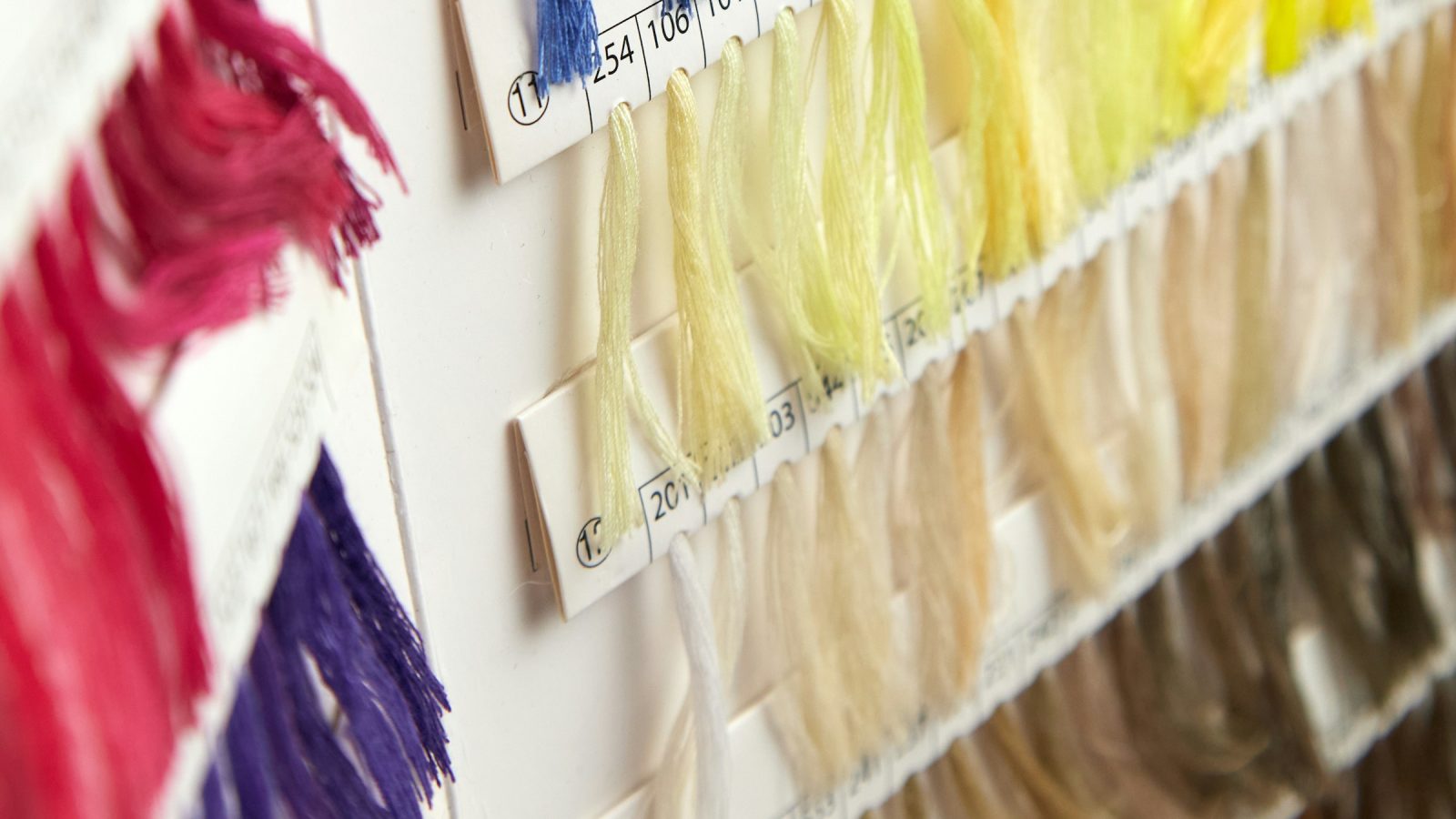
Every professional color box carries a code: 7/0, 8-00, 5NN, 010/36. The first number is the level, how light or dark the result will be. What follows is the tone, the color you see at that depth. Read both and you can predict what a shade will do, how much lift a formula needs and which warmth you will have to control.
This guide explains hair color levels 1 to 10, the pigment each level exposes, and how eight professional brands write their tones, decoded from their own charts.
Key takeaways
- Level is depth: 1 is black, 10 the lightest blonde, and some lines add 11 or 12. Level names vary by brand, so go by the number.
- Lightening exposes warm pigment. Wella lists red at levels 3–4, red-gold at 5, gold at 6–7, yellow at 8–9 and pale yellow at 10. Other brands’ charts differ slightly.
- The tone follows the level as numbers (7/1, 7-1) or letters (7A), and the same digit or letter can mean a different tone in another brand.
- Lift sets the developer, exposed pigment sets the tone, gray sets how much natural shade you need, and every service starts with a 48-hour allergy alert test.
The level system: 1 to 10 and beyond
Level describes lightness only, regardless of tone. Most professional lines run from 1 (black) to 10 (lightest blonde). Past 10, Wella’s Color Charm chart lists 12 as high lift, Schwarzkopf’s IGORA ROYAL Highlifts come in 10- and 12- series, and Joico’s Blonde Life chart runs to 12.
Names vary more than numbers: Wella, Schwarzkopf, Goldwell and Paul Mitchell call level 6 dark blonde, while Matrix and Joico’s Vero K-PAK chart call it light brown. A 6 is still a 6.
| Level | Name (Wella) | Exposed pigment: Wella | Matrix | Joico |
|---|---|---|---|---|
| 1 | Black | Black | Dark red brown | Blue |
| 2 | Very dark brown | Brown | Red brown | Blue/violet |
| 3 | Dark brown | Red | Dark red | Violet |
| 4 | Medium brown | Red | Red | Red violet |
| 5 | Light brown | Red gold | Red orange | Red |
| 6 | Dark blonde | Gold | Dark orange | Red/orange |
| 7 | Medium blonde | Gold | Orange | Orange |
| 8 | Light blonde | Yellow | Dark yellow | Yellow/orange |
| 9 | Very light blonde | Yellow | Yellow | Yellow |
| 10 | Lightest blonde | Pale yellow | Pale yellow | Light yellow |
Top: approximate natural shade at each level. Dot: the pigment exposed when hair is lightened to that level. Screen colors are approximate; use your swatch book.
Source: Wella Color Charm education book. Other brands' charts differ slightly. · Oh Baby Nails & Hair · obbnails.com
How to judge a natural level
- Read the regrowth. Only untouched hair at the scalp shows the natural level; colored or sun-faded ends mislead.
- Use the natural swatches. Wella and Joico both compare against the natural (N) family in their swatch books, and Joico warns not to confuse level with tone. Judge lightness, not warmth.
- Check front and back. Schwarzkopf notes they can differ by as much as two levels, and the client mostly sees the front.
- Dry hair, good light. Check dry hair in neutral light, near a window if you can; wet hair looks darker.
- Estimate the gray. Joico checks the temple, front hairline, crown, nape and sides: natural color seen first means under 50% gray; gray seen first means 50% or more.
Underlying pigment: the warmth each level exposes
Natural color comes from brown-black eumelanin and reddish pheomelanin. When you lift, the eumelanin breaks down more readily, so the warm pheomelanin shows through more and more; Schwarzkopf describes it shifting from red to orange to yellow before it finally dissolves. That exposed warmth is the underlying (contributing) pigment, and it mixes with the tone you deposit. Wella’s own example: lifting a natural level 5 to level 7 exposes red and gold, which can leave the result too warm unless the formula counteracts it.
Brands’ charts differ slightly. At level 7, Wella lists gold, Matrix and Joico list orange, and Goldwell says “extra light orange or dark gold”. The direction is the same everywhere, red to orange to yellow, so use the chart for the line in your bowl.
Tones: the number or letter after the level
Everything after the level is the tone: main tone first, then any secondary tone.
Number systems
Wella puts the tone after a slash: in its 4/71 example, 4 is the depth, 7 the major tone and 1 the minor tone. Schwarzkopf’s IGORA and Danger Jones use a dash (7-1, 4-66). Matrix and Joico print a decimal code beside their letters, such as 6.01 or 10.88. The digits are not universal:
| Digit | Wella (/) | Schwarzkopf IGORA (-) | Danger Jones Gloss (-) | Matrix (.) |
|---|---|---|---|---|
| 0 | Natural | Natural | Natural | Neutral |
| 1 | Ash | Cendré (blue/violet) | Ash | Ash |
| 2 | Matte (green) | Ash (blue) | Violet | Violet |
| 3 | Gold (yellow) | Matte (green) | Gold | Gold/warm |
| 4 | Red | Beige (muted gold) | Copper | Copper |
| 5 | Mahogany (red/violet) | Gold | Mahogany | Brown |
| 6 | Violet | Chocolate (warm brown) | Red | Red |
| 7 | Brown | Copper (orange) | Matte | Jade |
| 8 | Pearl (blue) | Red | Brown | Mocha |
| 9 | Cendre (blue/violet) | Violet | – | Pearl |
So /2 in a Wella box is matte, -2 in an IGORA box is ash, and 2 in a Danger Jones gloss is violet.
Letter systems
Letter lines write the tone as letters (7A, 5NN). In Wella Color Charm and Goldwell, the first letter is the main tone and the second a supporting tone. N (natural), A (ash), G (gold), R (red) and V (violet) are common, but read the legend:
- N is natural in Wella Color Charm and Goldwell but neutral in Matrix SoColor. Kenra says its Studio Stylist Express N series “is considered Neutral, not Natural”.
- C means cool in Wella Color Charm and copper in Kenra Color; Goldwell uses K for copper.
- B is brown at level 6 and below and beige at 7 and above in Goldwell, brown/beige in Kenra Color, and beige in Joico’s Vero K-PAK.
- T is titanium in both Joico Blonde Life and Matrix Tonal Control, yet Joico codes it .88 and Matrix .12.
Double letters, zeros and plus signs
- Double letters. Wella Color Charm says two identical letters, such as AA, give a more intense result. Paul Mitchell names NN “neutral neutral”, and Goldwell recommends NN shades for resistant, coarse hair or intensive gray coverage.
- Zeros. IGORA ROYAL -00 is Natural Extra, with up to 25% more color pigment than the Natural shades for coverage on thick, coarse hair. The final 0 in IGORA ROYAL Absolutes codes (7-60, 7-140) is the natural tone in a line formulated for white hair. A 0 before a Wella Shinefinity depth (07/0) marks a translucent, zero-lift glaze.
- Plus signs and prefixes. Paul Mitchell’s Plus series (N+, CH+, CNB+) carries an extra dose of background color for gray, white and resistant hair. Joico’s Age Defy shades (6NN+, 4NA+) are pre-mixed with more concentrated dye for hair that is 50% or more gray. Matrix SoColor puts 50 in front of extra-coverage shades for hair over 50% gray (505N).
The shades on our shelf, decoded
Shades we carry, read with each brand’s own legend:
| Shade | Brand and line | Level | Tone |
|---|---|---|---|
| 07/0 | Wella Shinefinity | 7, medium blonde | Natural; 0 in front = zero-lift glaze |
| 010/36 | Wella Shinefinity | 10, lightest blonde | Gold + violet |
| 8-00 | Schwarzkopf IGORA ROYAL | 8, light blonde | Natural Extra |
| 7-140 | IGORA ROYAL Absolutes | 7, medium blonde | Cendré + beige + natural |
| 4-66 | Danger Jones Gloss Toner | 4 | Red + red |
| 9-32 | Danger Jones Gloss Toner | 9 | Gold + violet |
| 5N | Paul Mitchell the color | 5, light brown | Natural |
| 5NN | Paul Mitchell the color | 5, light brown | Neutral neutral |
| 7A | Paul Mitchell the color | 7, blonde | Ash |
| 6NN+ | Joico Vero K-PAK Age Defy | 6, light brown (Joico) | Natural natural; Age Defy gray coverage |
| 4BN | Goldwell Colorance Gloss Tones | 4, medium brown | Brown + natural |
| 10PV | Goldwell Colorance Gloss Tones | 10, extra light blonde | Pearl + violet |
| 5N | Kenra Studio Stylist Express | 5 | Neutral, not natural |
| 505N | Matrix SoColor Pre-Bonded | 5, medium brown (Matrix) | Extra coverage + neutral |
| 8T | Matrix Tonal Control | 8, medium blonde (Matrix) | Titanium |
| 10T | Joico Blonde Life Demi Gloss | 10, lightest blonde | Titanium, an extra cool blue base |

Using levels and tones to formulate
- Find the natural level and the percentage of gray as described above.
- Count the lift. Natural 5 to target 7 is two levels, and lift decides the developer. Wella’s Koleston Perfect uses 20 volume (6%) for one level and gray coverage, 30 volume (9%) for two and 40 volume (12%) for three; Joico’s chart gives 1–2, 2–3 and 3–4 levels for the same volumes. More in our developer volume guide.
- Neutralize or enhance the pigment at the target level. Opposites on the color wheel cancel: violet neutralizes yellow, blue neutralizes orange, green neutralizes red. Paul Mitchell’s rule: to neutralize, choose the tone opposite the dominant pigment at the target level; to intensify, choose the same or a neighboring tone. For upkeep, see purple vs blue shampoo.
- Build gray coverage on the natural series. Wella adds a Pure Naturals shade to Koleston Perfect: one third of the color for 30–50% white hair, half for 50–100%. Schwarzkopf mixes one part IGORA ROYAL Natural with two parts Fashion shade for 100% coverage. More in how to cover resistant gray hair.
- Know when color cannot get there. Joico: artificial color will not lift artificial color. Wella’s Koleston Perfect Special Blondes lift 4–5 levels mixed 1:2 with 12%, and IGORA ROYAL Highlifts 12- lift up to 5 levels on base 6 and lighter. Schwarzkopf notes that pheomelanin resists lifting more than 4 levels, so bleaching is often needed. Beyond that, pre-lighten, then tone; see powder vs cream lightener.
- Patch test. Wella and Joico call for an allergy alert test 48 hours before every color service, and the FDA advises a patch test every time before dyeing. Follow our 48-hour patch test guide.
Shop hair color at OBB
Our Westminster store carries color from the brands in this guide, including:
- Wella Koleston Perfect ME+ (Pure Naturals) and Wella Shinefinity Zero Lift Glaze
- Schwarzkopf IGORA ROYAL, IGORA ROYAL Absolutes and IGORA ROYAL Highlifts
- Paul Mitchell the color, including Gray+ Coverage
- Joico Vero K-PAK Color Age Defy and Joico Blonde Life Demi Gloss
- Goldwell Topchic and Goldwell Colorance Gloss Tones
- Matrix SoColor Pre-Bonded and Matrix Tonal Control
- Kenra Studio Stylist Express and Danger Jones Gloss Toner with Bonder
Browse everything in Color, Developer & Lightener, or call or text (949) 591-5304 with your list and we will confirm stock and pricing.
FAQ
What do the numbers on hair color mean?
The first number is the level, from 1 (black) to 10 (lightest blonde), with 11 or 12 for high-lift blondes in some lines. The digits after the slash, dash or dot are the tone, main tone first. What each digit means depends on the brand.
What does N mean in hair color?
Usually natural, as in Wella Color Charm and Goldwell. Matrix SoColor uses N for neutral, and Kenra’s Studio Stylist Express N series is neutral rather than natural.
Why does lightened hair turn orange or yellow?
Lifting exposes the warm pigment underneath. By Wella’s chart you meet red-gold around level 5, gold at 6–7 and yellow at 8–9. Counteract it with the opposite tone: blue for orange, violet for yellow.
Can permanent color lift more than a few levels?
Only high-lift shades on natural hair: Wella’s Special Blondes reach 4–5 levels, and IGORA ROYAL Highlifts 12- up to 5 on base 6 and lighter. For more lift, or on previously colored hair, use lightener.
Sources
- Wella Professionals, Wella Color Charm Education Book, Koleston Perfect technical folder, Koleston Perfect fact sheet and Shinefinity usage guidelines
- Schwarzkopf Professional, The IGORA Numbering System, IGORA ROYAL Technical Manual, IGORA ROYAL Highlifts and IGORA ROYAL Absolutes
- Goldwell, All About Color, USA edition
- Paul Mitchell, Paul Mitchell The Color product knowledge and its paper chart
- Joico, Vero K-PAK Resource Guide, Blonde Life swatch chart and Blonde Life Titanium fact sheet
- Matrix, Tonal Control shade chart and SoColor shade chart
- Kenra Professional, Studio Stylist Express 5N and Kenra Color shade list
- Danger Jones, Gloss Toner swatch chart
- U.S. Food & Drug Administration, Hair Dyes
This article is general education for licensed professionals. Always follow the instructions that come with the product you are using.