

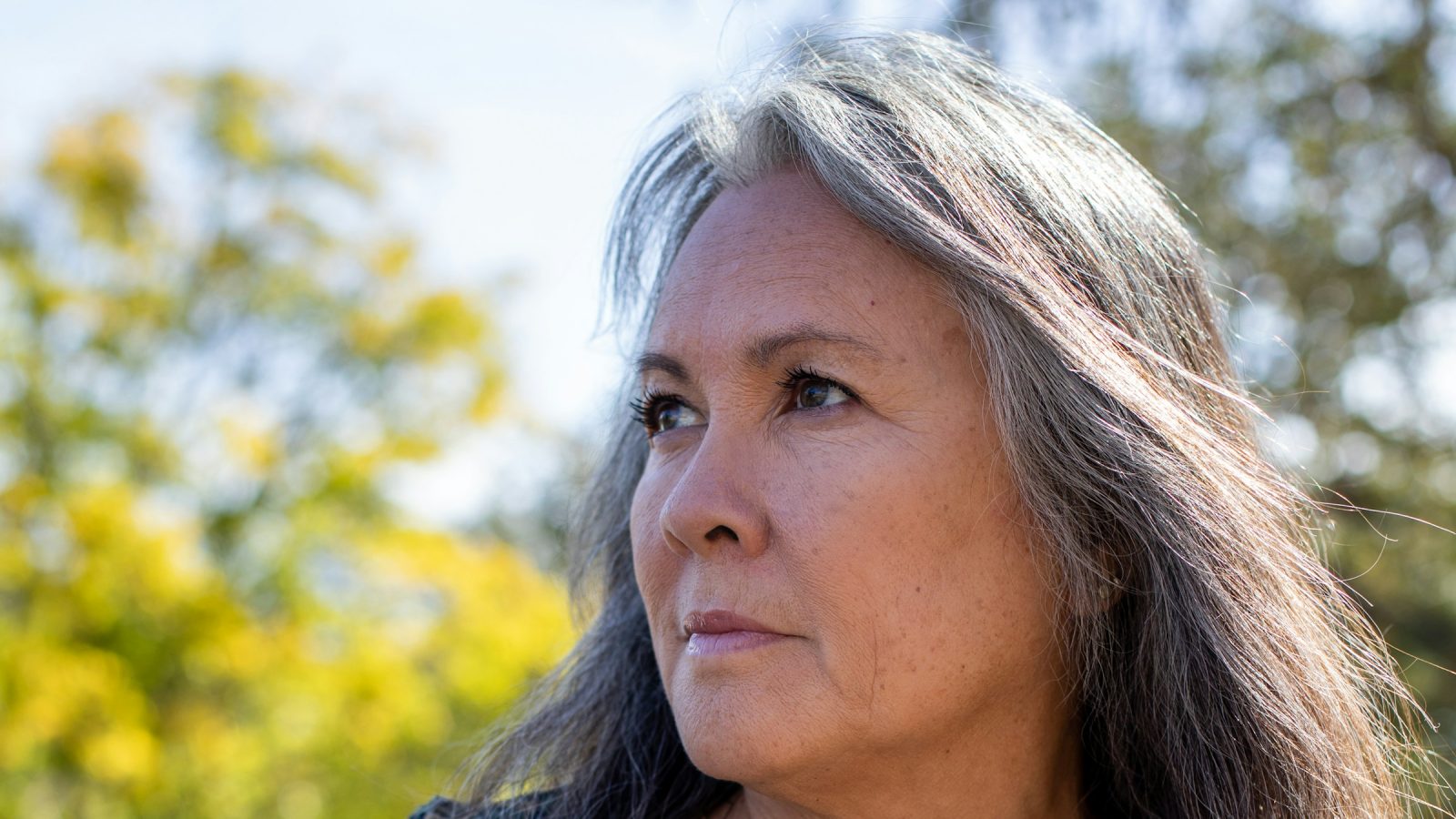
Every colorist knows the client whose temples still show through after a full permanent service. Resistant gray hair is slower to take color than the rest of the head, so a formula that covers the crown can leave the hairline see-through. The fix is rarely a stronger developer. It is a better map of the gray, the right base, careful application and full processing time, as the makers of the lines we carry at OBB explain below.
Key takeaways
- Gray hair has no melanin and often, though not always, grows coarser and drier. Kenra says it typically resists color because of a harder cuticle layer.
- Build the formula on natural or dedicated gray-coverage shades, in the proportion the maker gives for the percentage of gray.
- Most lines cover gray with 20 volume at their own ratio; stronger developer adds lift, not coverage. IGORA ROYAL Absolutes is the exception, with 30 volume as standard.
- Start on the most resistant area, use fine sections, saturate and process the full time. Heat only where the maker allows it.
- Do an allergy alert (patch) test 48 hours before every color service.
Why some gray hair resists color
Hair turns gray or white when the follicles stop making melanin, the pigment that colors hair, according to the American Academy of Dermatology. The Canadian Dermatology Association notes that gray first appears around the temples and the top of the head.
Losing pigment often changes the fiber too. Joico says hair can change in texture as it loses pigment, becoming more difficult to manage and color, and that declining lipids can leave it coarse and wiry. Wella adds that the scalp supplies less natural oil over time. Kenra says gray is typically more resistant to coloration because of a harder cuticle layer, and it needs more pigment for coverage. This is the stubborn gray colorists call coarse or glassy.
Not every gray strand is tough: Wella notes gray can be fine and wispy, and hairline hair is often finer and may grab color darker. A 2011 study in the International Journal of Cosmetic Science found few differences between pigmented and gray fibers across its group but many within individual people. Consult first.
Consultation: map the gray before you mix
- Percentage. Joico checks the temple, front hairline, crown, nape and sides: natural color seen first means under 50% gray; gray seen first means 50% or more. Wella uses the shade selector in its Koleston Perfect chart.
- Location. Wella usually finds gray concentrated at the front, especially the temples; Goldwell names the hairline, temples, crown or a white patch. Joico starts Age Defy retouches at the back nape, which it says tends to be the most resistant area. Where zones differ a lot, Wella and Joico suggest two formulas.
- Natural level. Read the regrowth against the natural (N) swatches; our guide to hair color levels and tones explains the codes.
- Texture and porosity. CHI asks you to consider both; porous ends soak up color that the root, per Wella, grabs less easily.
- Upkeep. Permanent color leaves a sharper regrowth line; Wella suggests demi- or semi-permanent color for clients who rarely visit.
Formulating for resistant gray
Build on natural or gray-coverage shades
Coverage comes from the base. Most lines add a natural (N, NN or NA) shade to the fashion shade, more as the gray rises; others make dedicated gray shades such as Joico Age Defy, IGORA ROYAL Absolutes, the Paul Mitchell Plus series and Matrix SoColor Extra Coverage. Combine them only as the maker directs: Joico warns that Age Defy on hair under 50% gray looks 1–2 levels darker, while Schwarzkopf says Absolutes covers more than 50% white hair without adding a natural.
Keep the developer at gray-coverage strength
Most lines cover gray with 20 volume (6%) at their own ratio, and Kenra keeps 30 or 40 volume for low gray when extra lift is needed. Stronger developer adds lift, not coverage; see our developer volume guide. Exceptions: IGORA ROYAL Absolutes recommends 9% (30 volume), or 6% (20 volume) for pure deposit on more than 90% white hair, and Pravana ChromaSilk mixes 1:1½. Joico advises against lifting more than two levels while covering gray.
Process the full time
Joico says to process Age Defy a full 45 minutes for maximum coverage, and Wella warns that results may be compromised if timing is not accurate. Wella and CHI start the timer once application is complete. Heat depends on the line: Schwarzkopf says no heat, and Pravana processes without it, while Wella allows a Climazon (15–25 minutes instead of 30–40) and Goldwell allows 20 minutes with heat on an open-air system only.

What each maker says
From each maker’s own guide, chart or FAQ (see Sources). Always check the leaflet in the box.
| Line | Gray-coverage shades or base | Developer, ratio | Time |
|---|---|---|---|
| Joico Vero K-PAK Color Age Defy | Premixed + shades with more concentrated dye, for 50% or more gray | Vero K-PAK 20 vol (6%) Veroxide, 1:1 | 45 min |
| Schwarzkopf IGORA ROYAL Absolutes | Up to 100% coverage on more than 50% white hair, no natural added. (IGORA ROYAL fashion shades on more than 50% white: 2 parts shade to 1 part Natural -0 or Beige -4; 1:1 on thick, resistant hair) | IGORA ROYAL Oil Developer 9% (30 vol), 1:1; 6% (20 vol) on more than 90% white | 30–45 min, no heat |
| Paul Mitchell the color | Plus series (N+, CH+, CNB+) for over 50% gray. Plus to fashion shade: 1:3–1:2 at 25–50% gray, 1:2–1:1 at 50–75%, 1:1–2:1 at 75–100% | Paul Mitchell Cream Developer, 1:1 | 35 min |
| Wella Koleston Perfect ME+ | ⅓ Pure Naturals at 30–50% gray, ½ at 50–100%; Resistant Cover shades (XX/0, cooler XX/02) for hard-to-cover gray | Welloxon Perfect 6% (20 vol), 1:1 | 30–40 min; 15–25 with heat |
| Goldwell Topchic | N, NN or NA at the target level. N to fashion shade: 15:25 ml up to 30% white, 20:20 at 30–60%, 25:15 at 60–100%. NN for resistant, coarse hair | Topchic Cream Developer Lotion 6% (20 vol), 1:1 | 30 min; 20 with heat (open-air system only) |
| Matrix SoColor Pre-Bonded | Extra Coverage shades (50 prefix, e.g. 505N) for 50–100% or resistant gray | Matrix Cream Developer 20 vol, 1:1 | 30–45 min, room temperature |
| Pravana ChromaSilk | N, Nt or Gold (.3) as 25%, 50% or 75% of the formula for 25%, 50% or 75%+ gray | Creme Developer 20 vol, 1:1½ | 45 min, no heat |
| CHI Ionic | Coverage Plus series for gray coverage | CHI developer, always 20 vol, 1:1 | 35 min, room temperature |
| Kenra Color Permanent | An N-series shade (N, NA, NB, NUA, N+, NW+) in every gray formula, in proportion to the gray | 20 vol standard, 1:1 | Up to 40 min for resistant gray |
Application techniques for stubborn gray
Start where the gray is most resistant
Joico says to always start in the most resistant gray area, and Wella says stubborn gray should get color first to benefit from the extra development time. The exception is fine hair at the face: with Resistant Cover shades, Wella recommends a lighter shade near the face, applied last, so the hairline doesn’t go too dark.
Fine sections, full saturation
- Joico takes ⅛-inch sections for Age Defy retouches; Paul Mitchell uses fine ¼-inch sections.
- Wella’s brickwork method works in fine sections, applying to both sides of each strand to avoid banding, then adds extra color to the most resistant strands.
- For resistant gray or thick hair, Wella mixes two bowls, the second one fresh for the back, because freshly mixed color gives maximum oxidation and coverage.
- Keep the coverage formula on the regrowth: CHI applies to new growth only, and Wella suggests a lighter formula on the lengths so they don’t turn darker than the roots.
Pre-softening: what it is and who calls for it
Goldwell’s glossary defines pre-softening as using a solution on gray or very resistant hair to allow better color penetration. Of the makers here, only Goldwell includes the step in its directions, and its version uses color, not plain developer: for Topchic, an N shade at the target level or one level lighter, mixed 1:1 with water, goes on concentrated white areas such as the hairline, temples or crown, followed immediately by the normal formula.
Colorists use other methods too, but the other makers here don’t include the step; they rely on more natural base, application order and full timing. Strand test anything outside the maker’s directions, and Schwarzkopf says not to apply color to a damaged or irritated scalp.
Additives: only the maker’s way
Joico’s Age Defy Gray Controller adds opacity for super resistant hair: up to 25% of the total formula, with the formula shifted 1–2 levels lighter. Gray Magic (Ardell) Gray Coverage Booster is a color additive for gray coverage; we could not confirm its current directions from the maker online, so follow the leaflet in the pack. Include any additive in your strand and allergy tests: Paul Mitchell tests the actual mixture you intend to use.
When full coverage isn’t the goal
- Demi-permanent blending. Wella suggests its demi Color Touch, or Color Touch Plus for up to 70% gray coverage. Kenra blends gray with its demi mixed 1:1 with 9 volume Activator on dry hair for up to 25 minutes, or on damp hair for less time for a softer blend. More in permanent vs demi vs semi-permanent color.
- Highlights. Wella suggests weaving highlights next to and on top of gray strands, and Kenra uses foilyage to blend partially gray hair.
- Quick coverage. Express lines cover gray in about 10 minutes (see 10 minute hair color), but for very resistant gray, Wella points to Koleston Perfect Intense Naturals and Paul Mitchell to the color at 35 minutes.
Patch test and aftercare
Do an allergy alert test 48 hours before every service. CHI requires one before each and every application, and the FDA advises a patch test every time you dye. See our 48-hour patch test guide.
Send clients home with a color-protecting shampoo and conditioner. Wella recommends moisture masks, since gray strands can be parched, and pre-booking every 4–6 weeks; Paul Mitchell’s consumer guide mentions touch-ups every three to four weeks. If blended or grown-out gray turns yellow, a violet product helps; see purple vs blue shampoo.
Shop gray coverage color at OBB
Our Westminster store carries the lines in this guide, plus products for blending and aftercare:
- Joico Vero K-PAK Color Age Defy and Schwarzkopf IGORA ROYAL Absolutes
- Paul Mitchell the color, including Gray+ Coverage and Wella Koleston Perfect ME+ (Pure Naturals)
- Goldwell Topchic, Matrix SoColor Pre-Bonded and Pravana ChromaSilk
- CHI Ionic Permanent Shine Hair Color with CHI 20 Volume Developer, and Kenra Color Permanent
- Gray Magic (Ardell) Gray Coverage Booster, used per its leaflet
- For blending: Kenra Color Demi-Permanent and Wella Color Touch (Rich Naturals)
- Aftercare: Joico K-PAK Color Therapy Color-Protecting Shampoo and Matrix So Silver Purple Pigmented Conditioner
Browse everything in Color, Developer & Lightener, or call or text (949) 591-5304 with your list and we will confirm stock and pricing.
FAQ
Why is gray hair so hard to cover?
It has no melanin and often grows coarser and drier with a harder cuticle, so it needs more pigment and time.
What developer is best for resistant gray hair?
Usually 20 volume at the brand’s ratio, as Joico, Wella, Goldwell, Matrix, Pravana, CHI and Kenra specify. Higher volume adds lift, not coverage. IGORA ROYAL Absolutes is the exception: 30 volume, or 20 on more than 90% white hair.
Should you pre-soften resistant gray hair?
Only if the maker’s directions include it. Goldwell pre-softens concentrated white areas with an N shade mixed 1:1 with water; the other makers here rely on more natural base, application order and full timing.
How long should color process on resistant gray?
The full leaflet time: 45 minutes for Joico Age Defy and Pravana gray formulas, 35 for Paul Mitchell the color and CHI Ionic, 30–45 for IGORA ROYAL Absolutes and Matrix SoColor.
Sources
- American Academy of Dermatology, What causes gray hair?
- Canadian Dermatology Association, Grey Hair
- International Journal of Cosmetic Science, Kaplan et al. (2011), Grey hair: clinical investigation into changes in hair fibres (abstract)
- Joico, Vero K-PAK Age Defy and Age Defy Essentials Guide
- Schwarzkopf Professional, IGORA ROYAL Absolutes and IGORA wall chart
- Paul Mitchell, The Color product knowledge, the color paper chart, the color 10 paper chart and How to Cover or Enhance Gray Hair
- Wella Professionals (Wellastore US), All You Need to Know About Gray Coverage, 10 Tricks for Resistant Gray, 5 Professional Tips and Koleston Xpress FAQ
- Goldwell, All About Color, USA edition
- Matrix, SoColor shade chart
- Pravana, FAQs and ChromaSilk 4N
- CHI (Farouk Systems), CHI Ionic and instruction sheet (PDF)
- Kenra Professional, 3 Ways to Cover (or Blend) Gray Hair and Gray Blending
- U.S. Food & Drug Administration, Hair Dyes
This article is general education for licensed professionals. Always follow the instructions that come with the product you are using.