

Paraffin dips are an easy add-on for manicures and pedicures: warm wax softens hands and feet, and clients love how it feels. Done carelessly, though, paraffin can burn skin, and a bath that is shared all day can get dirty. This guide covers safe temperatures, which clients should skip paraffin, a clean step-by-step routine, how to keep the bath clean, and the California rules that apply to the service.
Key takeaways
- In California, paraffin treatments for hands and feet are within a manicurist’s scope of practice. The Board has no paraffin-specific rule, but its general health and safety rules apply.
- Professional paraffin baths hold wax at about 125–135°F (52–57°C). Always test the wax on the inside of your own wrist before a client dips.
- Skip paraffin on broken, inflamed or infected skin, and for clients with poor circulation or lost feeling in the hands or feet, such as diabetic neuropathy.
- Wax that has touched a client’s skin goes in the trash, never back into the bath. Paraffin bags are single-use.
- Keep the bath covered when it’s not in use. Clean it when the wax turns cloudy or sediment collects on the bottom.
What California’s rules say about paraffin
None of the health and safety regulations in Title 16 of the California Code of Regulations (16 CCR) mention paraffin by name. The California Board of Barbering and Cosmetology’s 2023 Manicurists flier lists paraffin wax treatment among the services within a manicurist’s scope of practice. Don’t confuse it with hair-removal waxing: the Board’s Waxing Safety Tips brochure says wax services are out of scope for manicurists, and that brochure is about removing hair.
These general rules still apply to a paraffin service:
| Rule | What it says | What it means for paraffin |
|---|---|---|
| § 983(b) | Wash your hands thoroughly with soap and water, or an equally effective alcohol-based hand cleaner, immediately before serving each client | Wash your hands before each paraffin client |
| § 984(e) | No services where the skin is inflamed or broken (abraded, cut) or where a skin infection or eruption is present | Don’t let clients with that kind of skin dip |
| § 988(a) | Liquids, creams, waxes and other cosmetic preparations are kept in clean, closed containers | Keep the bath covered |
| § 988(c) | Products are taken out in a way that doesn’t contaminate what’s left | Never pour used wax back; no dirty ladle or brush in the bath |
| § 981(a), (b) | Items that touch the client and can’t be disinfected are thrown away right after one client; new supplies and single-use tools are stored in a clean, covered place labeled “New” | Paraffin bags and used wax go in the trash after each client (the rule doesn’t name paraffin bags, but they are single-use); store new bags covered and labeled “New” |
| § 987 | Towels are used once, then placed in a closed container; laundering is commercial, or at least 160°F for at least 25 minutes | Towels wrapped around hands or feet after the dip |
Under the Board’s fine schedule (16 CCR § 974), a § 984(e) violation costs $100, then $250, then $500; § 988 and § 983 violations cost $50, then $100, then $150. The Board hasn’t said whether terry mitts count as towels under § 987. The safe approach is to launder them like towels after each client.
How other states spell it out
A few states have written paraffin rules. They don’t apply in California, but they show what counts as good practice:
- Maryland: the client’s skin is free of breaks or skin disorders; hands or feet are properly disinfected before dipping; a disposable plastic covering goes on before cloth mitts, boots or towels; mitts and towels are kept in a closed container; wax removed from a client is discarded after each use; and the wax is kept free of debris.
- Washington: wax is covered except during the service and kept at the manufacturer’s temperature; a portion can be separated from the main pot for one client, and double-dipping is allowed only from that single-client container; wax that touched a client’s skin is never reused; and pots are cleaned and disinfected as the manufacturer directs.
- Oregon: wax is covered when not in use, kept at the manufacturer’s temperature, free of debris, and disposed of right after use.
- Mississippi (temporary rules posted February 2026): wax is used once and discarded, never returned to the heater; skin is dried completely with a clean towel before dipping; and wax is discarded when it’s cloudy or contains debris.
- Connecticut: wax is dispensed in a way that protects the unused supply, such as in a bag for one client; units are kept covered and wiped down outside at least daily; and contaminated wax is discarded and the unit emptied and disinfected.
The common thread: healthy, clean skin, used wax that is never reused, and a bath that stays covered and free of debris.
Temperature and the wrist test
- Professional units hold wax at about 125–135°F (52–57°C). Therabath lists 126–134°F, and WaxWel about 125–135°F.
- Before a client dips, test a little wax on the inside of your own wrist. Our paraffin wax product page says the same.
- Feet are usually more sensitive to heat than hands. Therabath suggests dipping only part of the foot on the first dip.
- Skin must be completely dry before dipping: water droplets on the skin can cause burns.
- Heat paraffin only in a paraffin bath. Never melt it on a stove or burner, in a microwave or in a plastic bag; paraffin is flammable.
Who should skip paraffin
Medical references and the bath makers’ instructions list these reasons not to dip:
- Broken skin, open wounds, rashes, inflammation or infection. Wait until it has fully healed (this is also § 984(e)).
- Poor circulation.
- Lost or reduced feeling in the hands or feet, such as diabetic neuropathy: the client can’t tell when the wax is too hot.
- Acute dermatitis.
In these cases, skip paraffin and suggest the client check with a doctor. Stop right away if a client feels pain, burning or discomfort.
Compiled from the bath makers’ instructions (Therabath, WaxWel), Maryland and Washington rules, and California’s general rules.
- Check the skin: no cuts, inflammation or infection. Ask whether the client has numbness, lost feeling or poor circulation (for example, from diabetes).
- Wash your hands (§ 983(b)). The client washes and completely dries their hands or feet and takes off rings and bracelets.
- Test the wax on the inside of your wrist.
- Dip a few layers as the manufacturer directs (Therabath: 3 dips for light moisturizing), waiting about 5 seconds between dips for the shine to fade. Or use a single-client portion.
- Slip on a new paraffin bag, then a terry mitt, bootie or towel to hold in the heat.
- Wait about 10–15 minutes, or as the unit’s instructions say.
- Peel the wax off inside the bag and throw the bag and wax away. Never pour wax back into the bath.
- Put towels and cloth mitts in a closed container for laundering (§ 987). Cover the bath.
Follow the instructions for your unit and wax. Not legal or medical advice.
Shared bath or single-client portions?
Dipping straight into the bath is the most common method. Therabath says paraffin contains no water and is held at about 130°F, so bacteria and fungi don’t survive long in the bath. That is the manufacturer’s claim. According to NAILS Magazine, the 1996 Oregon State University study it relies on also sampled wax from 22 salons and found traces of bacteria and fungi in several samples; the researchers linked them to skipped sanitation, used wax poured back into the bath, and heavy use without adding fresh wax. A representative of Therabath’s maker also told NAILS that 128–130°F won’t sterilize the wax.
For more certainty, give each client their own wax:
- Ladle: ladle wax from the bath into a paraffin bag or disposable cup for one client. Keep the ladle clean: clean and disinfect it after each client, or scoop with a disposable cup instead.
- Brush: move wax into a single-client container and brush it on.
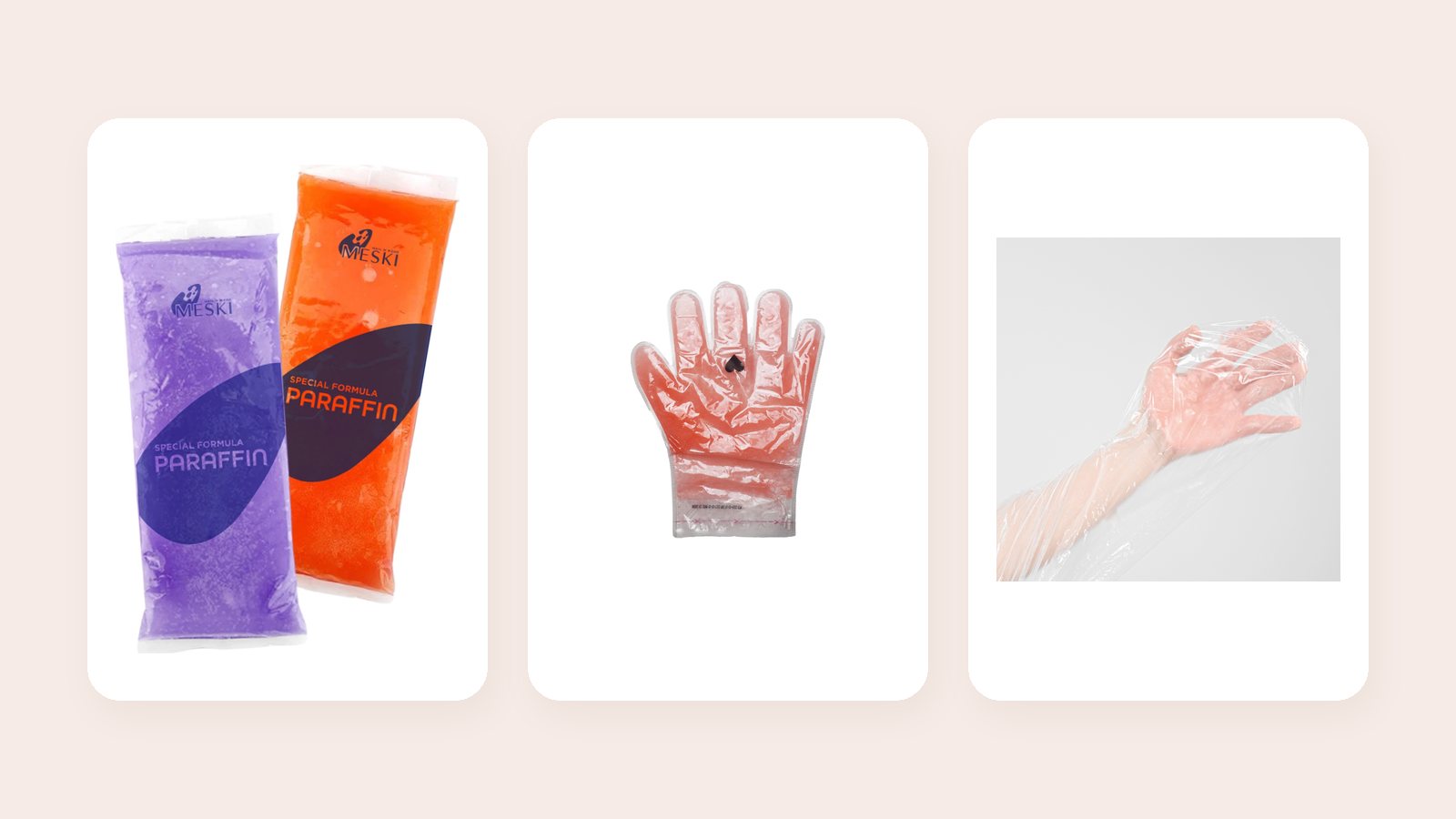
- Pre-filled masks: single-use glove- or bootie-shaped packs that already hold the wax. Warm and time them as the pack directs.
Keeping the bath clean
- Keep the lid on when the bath isn’t in use, so filing dust, powder and hair can’t fall in.
- Clean the bath when the wax turns cloudy or sediment builds up on the bottom. Therabath’s method: unplug it, let the wax harden overnight, lift out the cake and wipe the tank dry. WaxWel says to clean the unit with a disinfectant, but never a chlorine or bleach cleanser.
- If you can, use separate units for hands and feet. Therabath recommends this for any unit that isn’t for personal use.
Paraffin supplies at OBB
- Paraffin Wax (Meski): 450 g bags in Lavender or Peach, 6 bags per box, 6 boxes per carton (36 bags). Melt it in a paraffin heater and follow the heater’s instructions.
- Single-use masks: Meski Paraffin Wax Premium Hand Mask and Foot Mask, 140 g, Lavender or Peach, 144 per case. Follow the directions on the pack.
- Paraffin bags: Paraffin Bag 12 × 17 in, 15 micron, Paraffin Bags No Print 11 × 19 in, 13 micron and Paraffin Bags Print “Warning”, 13 micron; 4 rolls per carton.
Browse Paraffin & Wax, or call or text (949) 591-5304 with your list and we will confirm stock and pricing.
Related reading: California pedicure spa cleaning requirements, what California nail techs can and can’t do with calluses and latex vs nitrile vs vinyl gloves.
FAQ
Can nail techs do paraffin treatments in California?
Yes. The Board’s Manicurists flier lists paraffin wax treatments for hands and feet within a manicurist’s scope of practice. Hair-removal waxing is not.
How hot should paraffin wax be?
Professional baths hold it at about 125–135°F (52–57°C). Always test it on the inside of your own wrist before a client dips, and take extra care with feet.
Can you re-melt and reuse paraffin after peeling it off?
Not in a salon. Wax that has touched a client’s skin is thrown away. Therabath and WaxWel both say never to put used paraffin back in the bath, and several states write that into their rules. California’s rule on waxes also requires taking product out without contaminating the rest (§ 988(c)).
How often should you change paraffin wax?
There’s no single number. NAILS Magazine reports that makers’ advice varies: some say every 25 uses, others monthly or a few times a year. Follow your unit’s instructions, and clean the bath and replace the wax whenever it turns cloudy or collects sediment.
Is paraffin safe for clients with diabetes?
Not for clients with poor circulation, numbness or lost feeling in the hands or feet, because they can’t feel when the wax is too hot. Suggest they check with their doctor first.
Sources
- California Board of Barbering and Cosmetology, Article 12 (16 CCR §§ 977–995), the Manicurists flier (2023) and Waxing Safety Tips
- Maryland, COMAR 09.22.02.06; Washington, WAC 308-20-110; Oregon, OAR 817-010-0055; Mississippi, Rule 11.9 (temporary rules, February 2026); Connecticut DPH, Salon Infection Control Guidelines
- Therabath, paraffin bath guide and Model TB7; WaxWel, Use and Care Guide
- Healthwise (Kaiser Permanente), Paraffin Wax for Arthritis; Physiopedia, Paraffin Wax Bath
- NAILS Magazine, The Big Dip: Paraffin Waxes (2009), Play It Safe With Paraffin (2005) and How to Keep Your Paraffin Unit Clean and Safe (2001)
This is a plain-language guide for salon owners, not legal or medical advice. Follow the instructions for your unit and products, and check the current regulations at barbercosmo.ca.gov.