

Pedicure clients often ask to have their calluses “shaved off.” In California, nail techs can’t do that: the rules allow smoothing a callus, not removing it, and razor-edged callus tools aren’t even allowed on the premises. This guide covers what the regulations and the Board’s own materials say about calluses, which tools are banned, why pumice is single-use, and a safe way to smooth calluses during a pedicure.
Key takeaways
- Licensees may smooth a callus but may not remove it, even when the client asks. The Board calls callus removal a medical procedure.
- Razor-edged tools for removing calluses, such as credo-style callus shavers, can’t be used or even kept in a salon. The establishment is fined $300, then $400, then $500 (16 CCR § 993).
- The Board’s materials also prohibit grater-type callus tools.
- Pumice stones and pads, emery boards and buffers are porous: use them on one client, then throw them away (§ 981(a)).
- For clients with diabetes or poor circulation, work gently and suggest they see a podiatrist.
Smooth, yes. Remove, no.
The California Board of Barbering and Cosmetology’s August 1, 2011 industry bulletin on callus removal is direct: a Board license never allows you to remove a callus, including when a client asks, because callus removal is a medical procedure. Licensees may smooth a callus, and may use a liquid callus smoothing product as the manufacturer directs, but the Board doesn’t allow a callus shaver, razor or rasp. The bulletin sums it up: “you can SMOOTH but not REMOVE a callus.” The Board’s 2025 pedicure safety tips for consumers say the same thing.
The regulations in Title 16 of the California Code of Regulations (16 CCR) draw the line by skin layer:
- § 992: only the outermost layer of skin, the epidermis, may be removed. Section 977 defines the epidermis as the non-living layer.
- § 991: removing, destroying, cutting or piercing skin beyond the epidermis is an invasive procedure. The section specifically includes abrading or exfoliating skin below the epidermal layers and removing skin with a razor-edged tool or similar device. Each violation carries a $500 fine.
In short, smoothing a callus down is fine. Shaving, cutting or grinding into the living skin underneath is not.
Based on 16 CCR, Business and Professions Code § 7320.1 and the Board’s guidance.
Allowed
- Soaking feet in warm water to soften the skin
- Smoothing a callus with a new pumice pad or foot file
- A liquid callus smoothing product, used as the manufacturer directs
- Metal tools used only to smooth and massage, disinfected after every client
Not allowed
- Removing a callus, even when the client asks
- Using, or keeping in the salon, a razor-edged callus tool (credo-style)
- Grater-type callus tools
- Working below the outer, dead layer of skin
- Reusing pumice, files or buffers on another client
The Board does not endorse or approve any specific tool. Not legal advice.
Banned tools and allowed tools
| Tool | What the rules and the Board say | Notes |
|---|---|---|
| Razor-edged callus tools (credo-style shavers) | § 993(a): no establishment may have on the premises or use any razor-edged tool for removing calluses | The establishment is fined $300, $400, then $500. The Board’s “Do Not Use These Tools” flier says licensees found with an illegal tool at their station, or using one, can also be fined up to $500 |
| Grater-type tools (perforated metal surfaces) | The Board’s 2025 Manicuring fact sheet says a manicurist can’t use cheese grater-type tools to remove calluses; its 2023 scope-of-practice flier lists shaving calluses with a grater-like tool as prohibited | The “Do Not Use These Tools” flier pictures perforated, grater-style metal tools, including an egg-shaped one |
| “Rasp” | The 2011 bulletin rules out a rasp, but the Board doesn’t define what a rasp is | The Board’s Vietnamese translation renders “rasp” with the everyday Vietnamese word for a file, which can make techs think every file is banned. A disposable file used for smoothing is an ordinary tool; § 981(a) only requires throwing it away after each client |
| Metal foot files used only for smoothing | Since 2011, Business and Professions Code § 7320.1 allows metal instruments for smoothing and massaging the hands and feet, and § 977 lists “metal files, metal smoothers” as non-electrical tools | Disinfect per § 979 after every client. Blade or grater surfaces are still prohibited. Using metal tools the law doesn’t allow is fined $250, then $500 |
| Pumice stones and pads, emery boards, buffers | § 981(a) names “pumice stones,” “buffers,” “emery boards” and “sponges”: items that can’t be disinfected are thrown away immediately after one client | Fined $100, $150, then $200 if they aren’t thrown away |
| Liquid callus softeners | Allowed by the 2011 bulletin, used as the manufacturer directs. § 992 allows only over-the-counter products, not products sold for physician’s use only | See the routine below |
On metal foot files: the law allows metal tools for smoothing, but the Board doesn’t endorse or approve specific tools, and no Board document says which metal files are acceptable. If you’re unsure about a tool, call the Board at (800) 952-5210. There’s also no Board guidance yet on files with a metal handle and replaceable abrasive pads; under the general rules, the metal handle is disinfected per § 979 and the abrasive pad, which is porous, goes in the trash after each client.
The Board’s Health and Safety Advisory Committee drafted language in 2022 and 2023 that would list “credo blade, rasp” as prohibited tools. As of February 2026 that proposal was still pending and had not become a rule.
Why pumice is single-use
Pumice is porous: it has tiny spaces that liquid can pass through, so the Board doesn’t accept that it can be disinfected. The Board’s Disinfecting Nail Files bulletin says it has received no scientific data showing that porous nail files can be disinfected, gives emery boards, pumice stones and orangewood sticks as examples of porous items, and says porous items can’t be used on more than one client even if they’re stamped “disinfectable.”
Section 981(a) now names “pumice stones” and “sponges” outright. Whether it’s volcanic stone or a manufactured pumice pad, the routine is the same:
- Use a new one for each client and throw it away afterward; don’t wash it to reuse.
- Store new ones in a clean, covered place labeled “New” (§ 981(b)).
- Single-use pedicure kits that pack the pumice, file, buffer and toe separator together make it easy to toss everything at once.
A safe callus-smoothing routine
Based on guidance from the American Academy of Dermatology (AAD), the American Podiatric Medical Association (APMA), NAILS Magazine and the Board:
- Check the feet first. Don’t work on broken skin, sores or infection on the feet or lower legs; the Board’s pedicure safety tips tell clients with broken skin or lesions on their lower legs not to get a pedicure. Ask whether the client has diabetes or poor circulation.
- Soak the feet in warm water for about 5–10 minutes to soften the skin.
- If you use a callus softener, wear gloves, apply it only to thick callused areas, keep it off healthy skin, leave it on for the time the label gives (often about 5 minutes), then wipe it off.
- Smooth gently with a new pumice pad or foot file, in circles or side to side. Don’t try to take it all off: AAD warns that removing too much skin can cause bleeding and infection. Stop if the client feels soreness or the skin turns red.
- Never use a callus shaver, a bladed tool or a grater-type tool.
- Clean up right away. Pumice, files and buffers go in the trash (§ 981(a)). Metal tools are cleaned of debris, washed with soap and water, dried, then fully immersed in an EPA-registered disinfectant used as its label directs (§ 979).
- Moisturize. AAD suggests moisturizing daily; creams with urea, salicylic acid or ammonium lactate help soften calluses over time.
Clients with diabetes or poor circulation
These are the clients to be most careful with, because a small scrape on the foot can turn into an infected sore:
- Mayo Clinic advises people with diabetes or poor blood flow to see a doctor before treating calluses themselves, and says people with diabetes shouldn’t use a pumice stone.
- APMA says people with diabetes should never remove calluses or corns themselves, and should ask a podiatrist about safe pedicure practices.
- FDA rules require over-the-counter corn and callus removers (salicylic acid) to warn against use by people with diabetes or poor blood circulation.
For these clients, work gently, don’t scrub hard, and suggest a podiatrist for calluses that are thick or painful and for deep corns.
Pumice, foot files and kits at OBB
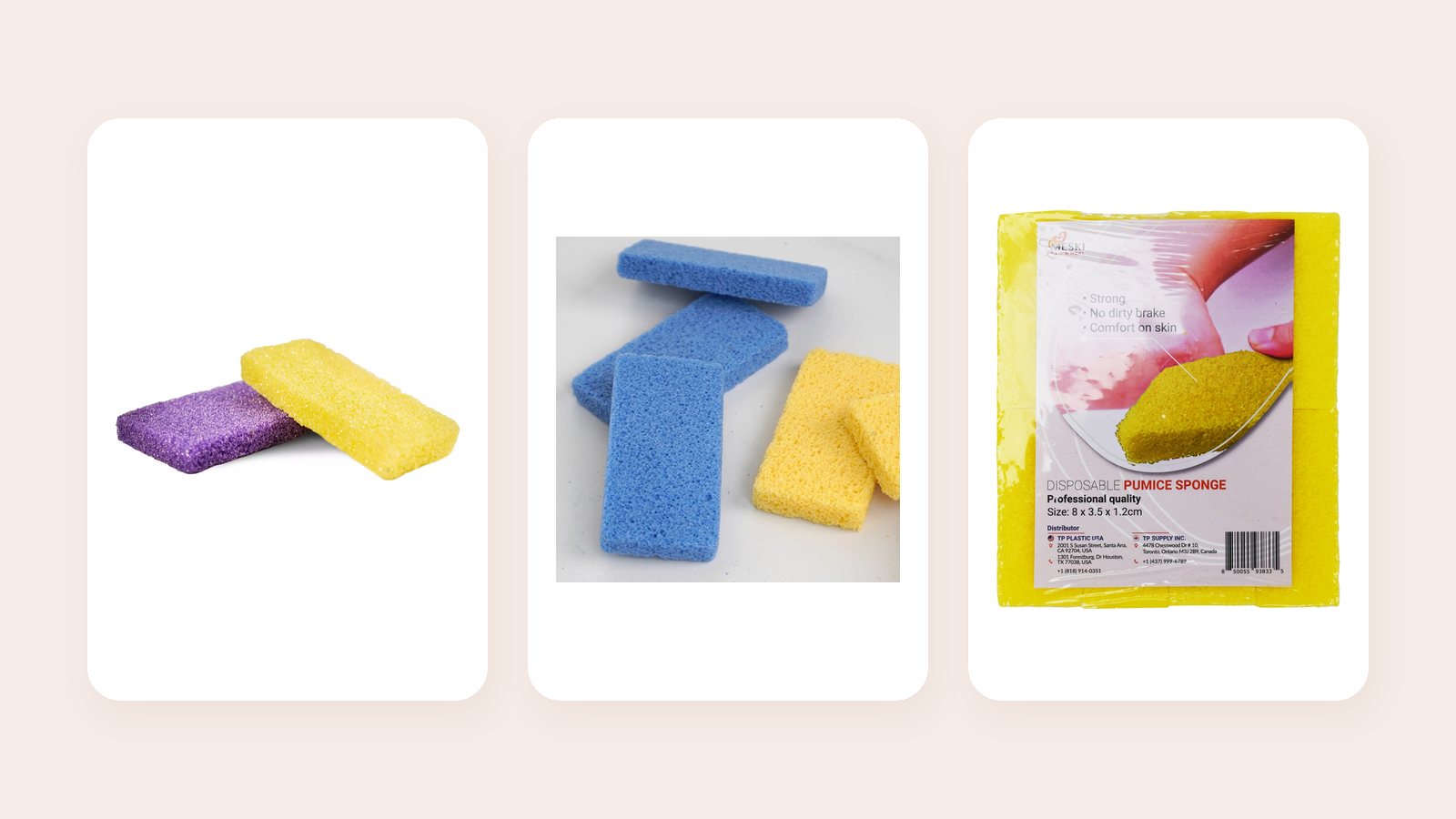
- Pumice Pad: purple or yellow, three sizes (8 × 3.5, 8 × 4 and 9 × 4.5 cm, 1.2 cm thick); 400 per inner case, 1,200 or 1,600 per carton.
- Pumice Pad New: 9 × 4.5 × 1.2 cm, 1,600 per carton.
- Pedicure Kit 4 EVA and Pedicure Kit 4 PE: a yellow pumice pad, an 80/80 Zebra file, an orange buffer and a toe separator in each set; 200 sets per case; the whole kit is single-use.
- Foot files: Pedicure File Premium Halfmoon, Premium Jumbo and Regular Jumbo (green, 7 × 1.1 in, 80/80 or 100/100), and Meski Jumbo Zebra 80/80; 1,000 per case.
Browse Pedicure Spa, or call or text (949) 591-5304 with your list and we will confirm stock and pricing.
Related reading: California pedicure spa cleaning requirements, paraffin wax safety for nail salons and latex vs nitrile vs vinyl gloves.
FAQ
Can a nail tech remove a callus if the client asks?
No. The Board says a license never allows callus removal, even at the client’s request. Nail techs may only smooth a callus.
Is it illegal to keep a credo blade in the salon if we don’t use it?
Yes. Section 993(a) bans having a razor-edged callus tool on the premises, not just using one. The establishment is fined $300, then $400, then $500.
Can pumice be disinfected and reused?
No. Pumice is porous and can’t be disinfected. The Board says porous items are for one client only, even if the package says “disinfectable.”
Are metal foot files legal in California?
The law allows metal tools for smoothing and massaging the hands and feet, and names “metal files, metal smoothers.” Blade and grater-type surfaces are still banned, and the Board doesn’t approve specific tools. If you use one, disinfect it per § 979 after every client; if you’re unsure, ask the Board.
Can nail salons use callus softeners?
Yes. The Board allows liquid callus smoothing products used as the manufacturer directs, as long as they’re sold over the counter and not for physician’s use only. Wear gloves and apply them only to thick callused areas.
Sources
- California Board of Barbering and Cosmetology, Article 12 (16 CCR §§ 977–995) and the fine schedule, 16 CCR § 974
- California Business and Professions Code, § 7320.1
- Board publications: Callus Removal (2011), Disinfecting Nail Files, Do Not Use These Tools (2022), Pedicure Safety Tips (2025) and Manicuring (2025)
- American Academy of Dermatology, How to treat corns and calluses; Mayo Clinic, Corns and calluses
- American Podiatric Medical Association, Pedicure Pointers and Corns and Calluses
- FDA, OTC Monograph M030: Corn and Callus Remover
- NAILS Magazine, Secret Ingredient: Callus Softeners (2011)
This is a plain-language guide for salon owners, not legal or medical advice. Check the current regulations at barbercosmo.ca.gov.