

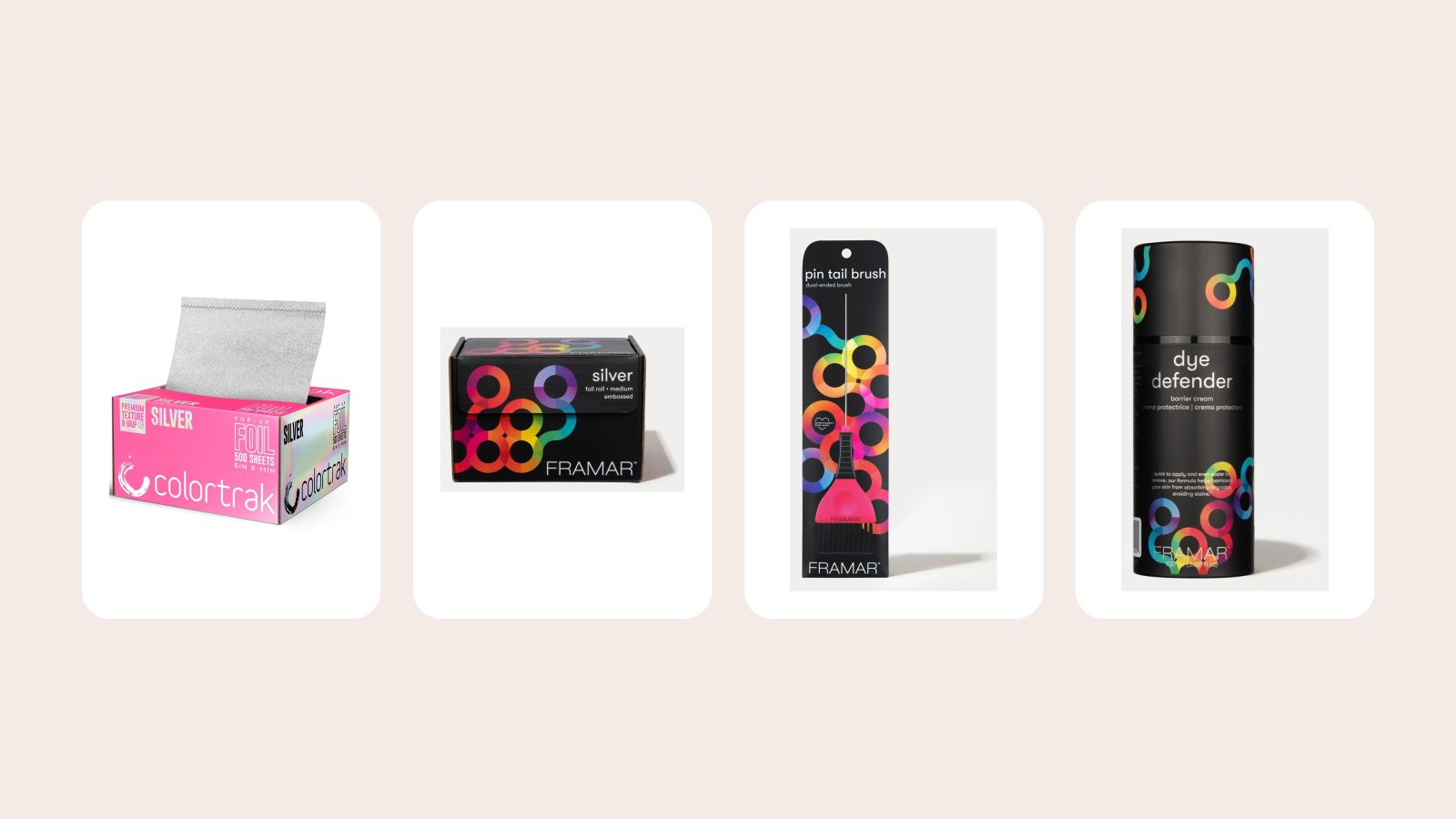
Pop-up hair foil comes pre-cut in a dispenser, so you grab a sheet and go; a roll lets you cut each sheet to the length the section needs, which helps on long hair. Embossed foil has a raised texture that the makers say grips hair and slips less, while smooth foil is flat. Here is how to choose, how to fold a foil that doesn’t leak, and which tools and California cleaning rules go with it.
Key takeaways
- Foil keeps lightener on the strands you chose. Joico warns that formula bleeding into other hair causes spots and lines of demarcation.
- Pop-up sheets are ready to use. Rolls cut to any length; Framar says that suits long hair and minimizes waste.
- Framar says many colorists feel embossed foil grips better. Colortrak suggests a different foil color for each formula.
- To stop bleeding, Joico’s educator mixes lightener to a toothpaste-like consistency and locks the foil tight at the root.
- In California, tools that touch a client are cleaned and disinfected before the next client; gloves, cotton and neck strips are thrown away after one client.
Why colorists use foil for highlights
For foil highlights, you paint lightener or color onto chosen strands and wrap them so the product stays off the hair around them. Wella’s education blog explains that sectioning shapes the result: a slice (a full, thin section) looks bolder, and a weave (strands picked out with a pintail comb) looks softer. Wella suggests spacing pieces ¼ cm to 1 cm apart, closer at the hairline to mimic the way the sun lightens hair.
Foil is there to prevent bleeding. Joico describes it as formula that bleeds into the client’s existing color during processing, the root cause of “unsightly spots and lines of demarcation.”
Foil also changes processing. Joico describes Foilyage as painted sections wrapped in foil “to conduct heat and deliver greater lift,” while balayage processes without foil or heat. Joico educator Mai Hernandez advises starting with a low developer for foil work, for more even lift without damaging the hair. Our developer volume guide explains the numbers; the lightener’s own directions on developer, heat and timing come first.
Pop-up foil vs foil roll: which one fits your service?
Both are aluminum foil. The trade-off is prep time versus control over length.
| Format | What the maker says | Good fit |
|---|---|---|
| Pop-up sheets, 5″ x 11″ | Colortrak: 500 pre-cut sheets in a pop-up dispenser. Framar: 500 sheets, pre-cut and pre-folded, “No prep needed!” | Full heads with many same-size foils |
| Roll | Framar Star Struck Silver Embossed Roll: 320 ft, medium weight, cut to any length in a dispensing box with a blade; “great for long hair and minimizes waste” | Long hair, or sections that need a custom length |
| Wide pop-up sheets, 9″ x 10.75″ | Reynolds 711: easy to fold, dispensed one sheet at a time; one sheet can be cut in half for two wraps | A wider sheet, or two narrow ones from one |
Sizes vary by brand, so check the box. If hair hangs past a pre-cut sheet, cut a longer piece from a roll.
Embossed vs smooth foil, foil weight and colored foil
Embossed or smooth. Framar explains that embossed foil has a different texture from regular smooth foil, and that “many colorists feel” it grips hair better and prevents slippage. Colortrak says the embossing on its silver pop-up foil gives “a more effective grip, fewer punctures, and less waste.” Neither maker we checked claims a specific advantage for smooth foil, so choose by feel.
Light, medium or heavy. Framar calls weight personal preference. Light foil gives more feet per roll, but some find it too flimsy. Heavy foil is very strong, and Framar says colorists who work with coarse hair find it works better. Medium is the weight its customers use most.
Colored foil. When a service uses more than one formula, Colortrak suggests a different foil color for each, so highlights and lowlights are easy to track. Framar’s “switch” pop-ups alternate two colorways in one box, which Framar calls “perfect for identifying highlights and lowlights.”
How to fold a foil so it doesn’t bleed
This “fold and lock” sequence comes from The Hair Care Group, an Australian salon distributor, with tips from Joico.
- Mix gently. Joico’s Olivia Smalley never whips lightener, because whipping “adds oxygen, which causes it to expand and ultimately, bleed into the foil.” She stirs it to a toothpaste-like consistency.
- Take your section. Slice or weave with the tail of a comb or a pin-tail brush.
- Fold a lip. Fold the top of the sheet over the comb tail, about 2–3 cm. Pre-folded pop-ups already have this edge.
- Lock it at the root. Place the foil right against the scalp and anchor both corners. Smalley calls tension “everything”: a foil locked at the root doesn’t slip, and slipping leads to bleeding.
- Paint down from the top of the foil until the section is saturated.
- Fold. Bring the bottom up just past halfway, push the pocket with the comb tail until the edges meet, then fold the sides toward the middle without over-folding.
- If one bleeds anyway, Joico suggests laying cotton right above the top of the foil as a barrier.
For placement, The Hair Care Group uses horizontal foils for soft, blended blondes, vertical foils for bolder contrast, and diagonal foils for face framing.
Brushes, combs, clips and bowls for a foil service
- Tint brush: a flat brush for spreading color. Framar says the tapered AccuSoft bristles on its Classic color brush spread color evenly and calls it great for balayage and foil work. For roots, Cricket says its Mega Roots Brush has an extra-wide head and dense, firm bristles.
- Pin-tail brush: a brush on one end and a thin metal tail on the other. Framar says you paint with one end and weave hair and fold foils with the other.
- Tail combs: Colortrak’s Pro Pack includes carbon fiber combs with a 5″ pintail for weaving, which Colortrak calls heat resistant and anti-static.
- Clips: Framar says its Gator Grips hold big sections with a wide, rubberized, no-slip mouth. Colortrak describes its croc clips as rubberized, double-hinged and stain-resistant.
- Bowls: check the lightener’s directions. Wella’s Blondor Multi Blonde, for example, is mixed in a non-metallic bowl.
Barrier cream, gloves and stain removers
First, the safety basics. The FDA says to do a patch test every time before dyeing, to wear gloves when applying hair dye, and never to dye eyebrows or eyelashes, because it can hurt the eyes and may even cause blindness. Wella’s Koleston Perfect directions call for an allergy alert test 48 hours before each coloration. Our 48-hour patch test guide shows how.
Barrier cream. Framar says its Dye Defender keeps hair color from sitting directly on the skin; apply it to the neck, ears and hairline before coloring, and it washes off with just water. Wella says to apply Color Preguard Cream to the hairline before color and wipe it away before shampooing.
Gloves. Poison Control says never to reuse disposable gloves, and notes that gloves don’t protect the scalp, neck, forehead, ears or eyelids. Material matters: in a 2015 study, volunteers already allergic to PPD reacted to a dark permanent dye through natural rubber latex, polyethylene and vinyl gloves, while nitrile protected them even after 60 minutes. Latex can also cause latex allergy, which OSHA calls a major workplace health concern. Our latex vs nitrile vs vinyl gloves guide is written for nail techs, but the glove facts apply at the color chair too.
Stain removers. Framar says Kolor Killer Wipes remove color stains from hands, neck and face and are gentle on all skin types. Colortrak’s Wipe Off wipes contain aloe, and Colortrak advises a patch test for sensitive skin. See also how to get hair dye off skin.
California rules: cleaning brushes and clips, tossing disposables
The Board of Barbering and Cosmetology’s Licensee Fact Sheet 2 sums it up: “Any tool that touches a customer must be disinfected before it can be used on another person.” The steps are in 16 CCR § 979, and § 977 names combs and hair clips as tools it covers. Color brushes aren’t named, but they touch the client. We found no rule that names mixing bowls.
Compiled from 16 CCR §§ 977 and 979 and the Board’s Licensee Fact Sheet 2.
- After the service, put used tools in a container labeled “Dirty,” “Soiled” or “Contaminated.”
- Remove all visible debris.
- Clean with soap or detergent and water.
- Dry completely with a new, clean paper towel.
- Totally immerse in an EPA-registered liquid disinfectant with bactericidal, fungicidal and virucidal activity, used as the label directs.
- Wear gloves or use tongs to take tools out.
- Store in a clean, covered place labeled “Clean” or “Disinfected.”
Keep the disinfectant covered and change it as the label directs or when it is cloudy or has debris in it. The Board also recommends a clean-water rinse after washing, though the regulation doesn’t require it.
Disposables. Under § 981, anything that touches a client and can’t be disinfected, including gloves, cotton pads, sponges and neck strips, goes in a waste container right after one client, and new single-use supplies are stored in a clean, covered place labeled “New.” Foil isn’t named, but a used sheet can’t be washed and immersed, so treat it as single-use. Section 981 also bars carrying tools or supplies “in or on a garment or uniform (including pouches and holsters)” while working, so keep clips on the station, not on your shirt.
Recycling. The Midway City Sanitary District’s 2026 sorting guide (Westminster area) lists aluminum foil as a blue-bin recyclable but says nothing about foil with color or lightener on it. Ask your hauler before recycling used salon foils.
At OBB
- Colortrak 500CT Silver Pop-Up Foil 5″ x 11″: 500 pre-cut embossed sheets.
- Colortrak Color Combo Pop-Up Foil 5″ x 11″: colored pop-up foil for keeping formulas apart.
- Framar Checked Out 5×11 Pop Up Foil: 500 pre-cut, pre-folded embossed sheets (Framar).
- Framar Extra Dirty 5×11 Switch Pop Up Foil: two alternating colorways in one box.
- Framar Star Struck Silver Embossed Roll, Medium: 320 ft that you cut to length.
- Reynolds 711 Pop-Up Interfolded Aluminum Foil Sheets: 9″ x 10.75″ sheets the maker sells for salon highlighting.
- Framar Extra Dirty 3PC Classic Color Brush Set, Framar Pin Tail Brush and Cricket Color Cocktail Mega Roots Brush.
- Colortrak Pro Pack (four brushes, four pintail combs, four croc clips) and Framar Extra Dirty Gator Grips.
- Framar Dye Defender Barrier Cream and Wella Professionals Service Color Preguard Cream.
- Framar Kolor Killer Wipes and Colortrak Wipe Off Hair Color Remover Wipes.
- Colortrak Pink Vinyl Disposable Gloves (single-use, latex-free, powder-free, per Colortrak) and Gloves Latex, 1000 pcs/carton; skip latex for anyone with a latex allergy.
Call or text (949) 591-5304 with your list and we will confirm stock and pricing, then pick up at our Westminster store.
Related reading: hair salon supply checklist, powder vs cream lightener and how to get hair dye off skin.
FAQ
What size foil is used for highlights?
Colortrak and Framar both size their 500-sheet pop-ups at 5″ x 11″. For longer hair, cut a longer piece from a roll or use a wider sheet such as Reynolds’ 9″ x 10.75″.
Is embossed foil better than smooth foil?
Framar says many colorists feel embossed foil grips hair better and slips less. Beyond that, it’s personal preference.
Why do my foils bleed?
Joico points to runny or whipped lightener and foils that slip at the root. Mix to a toothpaste-like consistency and lock the foil against the scalp.
Can I reuse foil or color brushes?
Not foil: California’s Board says anything that touches a client and can’t be disinfected is thrown away after use. Brushes can be reused after cleaning and full immersion in an EPA-registered disinfectant.
Sources
- U.S. Food & Drug Administration, Hair Dyes (content current as of September 25, 2025)
- California Code of Regulations, Title 16 (Cornell LII): § 977 Health and Safety Definitions, § 979 Disinfecting Non-Electrical Tools and § 981 Tools and Supplies
- California Board of Barbering and Cosmetology, Licensee Fact Sheet 2: Disinfection (revised March 2024)
- Poison Control (National Capital Poison Center), Concerns about hair dye
- Contact Dermatitis (Antelmi et al., 2015), Are gloves sufficiently protective when hairdressers are exposed to permanent hair dyes?
- OSHA, Latex Allergy
- Joico, Yikes! Your Foils Are Bleeding and Balayage vs Foilyage
- Wella Professionals, How to Section Hair for Highlights & Balayage, Blondor Multi Blonde, Koleston Perfect fact sheet and Color Preguard Cream
- The Hair Care Group, Foiling techniques and placements
- Framar, FAQ, Checked Out Pop Up, Extra Dirty 5×11 Pop Up, Star Struck Silver Embossed Roll Medium, Classic Color Brush Set, Pin Tail Brush, Gator Grip Clips, Dye Defender and Kolor Killer Wipes
- Colortrak, FAQ, 500CT Silver Pop-Up Foil, Pro Pack, Pink Vinyl Disposable Gloves and Wipe Off Hair Color Remover Wipes
- Cricket, Color Cocktail Mega Roots Brush
- Pactiv Evergreen (Reynolds foodservice), Reynolds 9″ x 10.75″ Pop-Up Aluminum Foil Wrap Sheets (711) and Hair Highlighting Foil Pop-Up Sheets
- Midway City Sanitary District, Sorting Guide (2026)
This article is general information for salon professionals. Follow the directions on every color, lightener and disinfectant label, and check current rules with the California Board of Barbering and Cosmetology. If a client’s skin reacts, stop the service and see a doctor.