

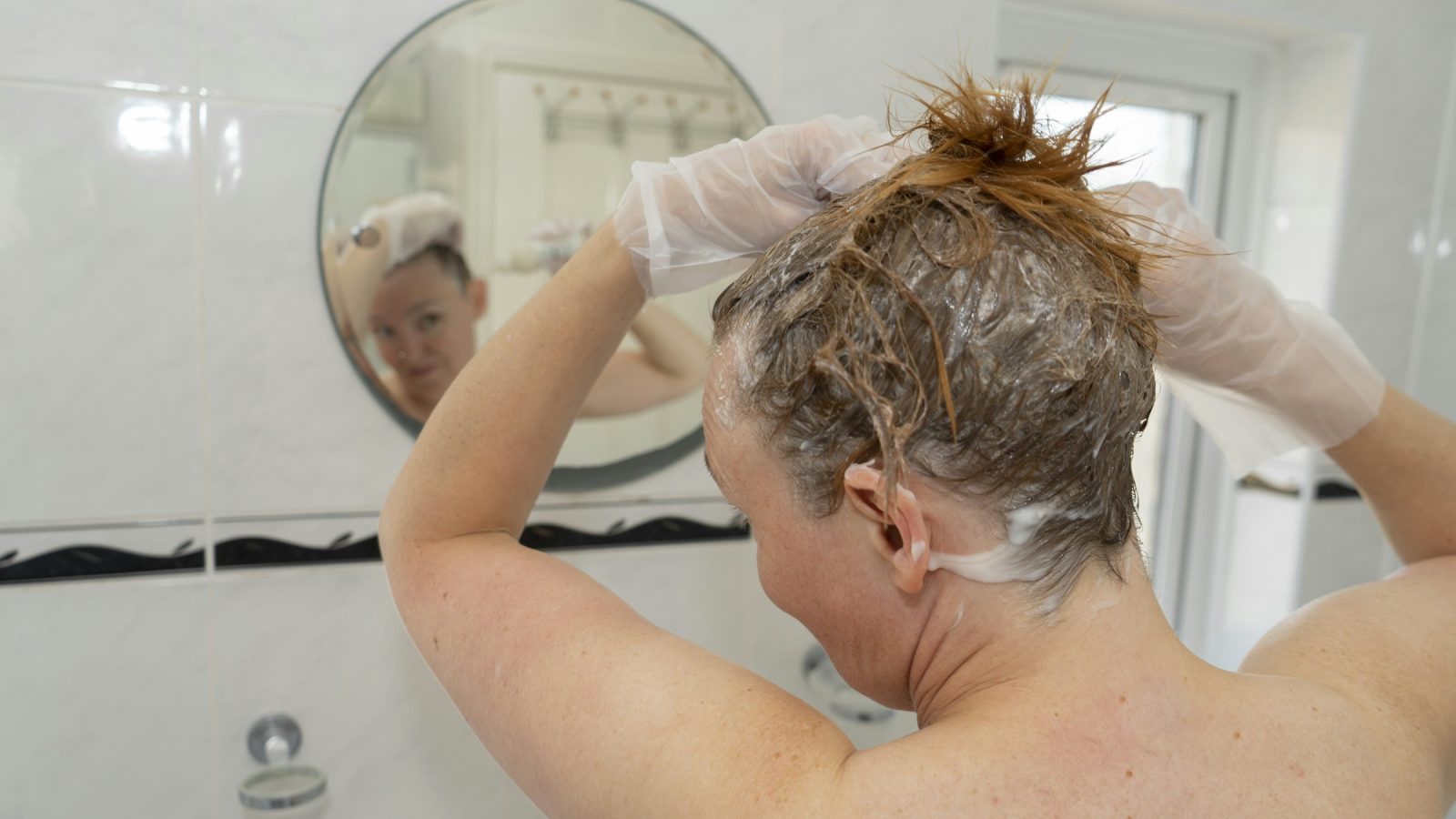
Every colorist knows the look: a brown line along the forehead, color on the ear tips, fingertips tinted after a root touch-up. The dyes that bind to hair also bind to proteins in the outer layer of skin, so stray color stains fast. Here is how to get hair dye off skin safely, whether you work behind the chair or color at home, plus which household tricks to skip and how to tell a stain from a reaction.
Key takeaways
- Prevent first: barrier cream along the hairline, ears and neck, gloves for every service, and wipe drips while they are still wet.
- Start gentle: water and a mild cleanser, then a hair color remover wipe or an oil-based makeup remover.
- Keep toothpaste, baking soda, nail polish remover and bleach off the face, and use nothing harsh near the eyes or on irritated skin.
- A plain stain fades in a few days. Itching, burning, redness, swelling or blisters can mean a reaction: rinse, stop and get medical advice.
- Do an allergy alert (patch) test 48 hours before every color service.
Prevention first: keep color off the skin
Prevention is easier than removal, and less dye on skin means less contact with potential allergens.
- Barrier cream. Before you start, apply a thin line along the hairline, around the ears and across the nape. Framar says its Dye Defender barrier cream blocks hair color from sitting directly on the skin and washes off with water. Wella describes Service Color Preguard Cream as a skin protection cream for professional color services, applied to the hairline before color and wiped away before shampooing. At home, board-certified dermatologist Purvisha Patel suggests petroleum jelly.
- Gloves, every time. The FDA says to wear gloves when applying hair dye, and Poison Control adds never to reuse them. Material matters: in a 2015 study, volunteers already allergic to PPD reacted to a dark permanent dye through latex, polyethylene and vinyl gloves, while nitrile gloves protected them even after 60 minutes. If you or a client already has a PPD allergy, choose nitrile.
- Cape, towel and clips. Cover clothing and the neck, and clip finished sections away from the face and ears.
- Wipe as you go. Keep water and cotton or soft non-woven wipes at the station, wipe drips as they land, and check the hairline, ears and nape again before processing starts.
- Protect the eyes. The FDA warns that hair dye can hurt the eyes and may even cause blindness, and says never to dye eyebrows or eyelashes.
At home, use petroleum jelly or a barrier cream, the kit’s gloves, an old towel and a timer; the FDA says not to leave dye on longer than directed. Salons can add these basics to their hair salon supply checklist.
How to get hair dye off skin: start gentle
Work down this list and stop once the stain is gone. Skin scrubbed raw is a bigger problem than a faint shadow that fades on its own.
- Wipe while it is wet. Healthline’s medically reviewed guide notes that wiping dye off before it dries may be all you need.
- Wash with warm water and a mild cleanser, then pat dry.
- Use a remover made for skin. Framar says its Kolor Killer Wipes remove hair color stains from hands, neck and face and are gentle for use on all skin types. Colortrak describes Wipe Off Hair Color Remover Wipes as pre-moistened towelettes infused with aloe to soothe skin, and advises a patch test for sensitive skin. Follow the label directions.
- Try an oil or makeup remover. Baby oil, olive oil, an oil-based makeup remover or micellar water on a cotton pad helps loosen dye. Wash it off afterward.
- Let it fade. The stain sits in the outermost layer of skin, which is made of dead cells the body keeps shedding. Because of that, Dr. Patel says stray color should fade within a few days.

Fresh vs dried stains
Fresh dye sits on the surface and usually lifts with the first three steps. Dried, developed dye is bound to the outer layer of skin: a gentle pass or two lightens it, and time does the rest. Harsher products mostly risk irritating skin just exposed to dye.
At the shampoo bowl
Wella’s Koleston Perfect directions call for emulsifying the color with a little warm water before rinsing; use that moment to massage the hairline and ear tips gently. For home color, Madison Reed’s colorists suggest working a little shampoo into the color along the hairline and ears before wetting the hair.
Hair dye on the hairline, hands, nails and near the eyes
Hairline, forehead, ears and neck
Most stains land here. Facial skin is delicate, so stick to water, a gentle cleanser, a remover wipe made for the face or an oil-based makeup remover, and wipe outward from the hairline. Never use nail polish remover on the face or neck. Color on the scalp is expected; rinse the scalp well with water, as the FDA advises.
Hands
Wash with soap and warm water, use a remover wipe, and go around knuckles and nail folds with a soft nail brush. Dish soap cuts greasy residue, but the AAD lists detergents among the chemicals that raise the risk of hand eczema, so moisturize afterward. For a stubborn spot, Dr. Patel’s last resort is rubbing alcohol dabbed on with a cotton round; it can be very drying, so rinse it off with soap and water right away. For stylists, gloves through the final rinse beat any remover.
Nails and cuticles
DermNet lists hair dye among the agents that stain nails, and a dermatology review in Skin Appendage Disorders notes that the pigment adheres to the nail plate, with an edge that follows the cuticle’s curve.
- Scrub gently with soap and a soft nail brush, and use a remover wipe on the cuticles and nearby skin.
- Do not cut away the cuticle to get color out; the AAD warns that removing it can damage the nail.
- Keep nail polish remover on the nail plate. The AAD says acetone that sits on skin can irritate and damage it, and suggests petroleum jelly on the cuticles and surrounding skin first.
- Color bonded to the nail lightens with washing and grows out with the nail. Filing it off only thins the nail.
A dark stripe running lengthwise down a nail is not a dye stain, and the AAD recommends having a dermatologist examine any new or changing dark streak.
Near the eyes
Gentle only, and keep every product out of the eyes. With the client’s eyes closed, wipe away from the eye with a cotton pad dampened with water or a gentle eye makeup remover. Skip stain remover wipes on the eyelids unless the label allows it, and never use alcohol, acetone or scrubs there. If dye gets into an eye, Poison Control says to rinse with room-temperature water for 15 minutes, then call 1-800-222-1222.
Household remedies: what is reasonable and what to skip
Some fixes are gentle enough for the face, some are for hands only, and one belongs nowhere near skin. None should go on broken or irritated skin.
| Option | Verdict | Why |
|---|---|---|
| Mild soap or face cleanser with warm water | Yes, start here | Gentle enough for the face; most effective on fresh dye. |
| Makeup remover or micellar water | Yes, including the face | Made for facial skin; oil-based ones help loosen dye. Keep out of the eyes. |
| Baby oil or olive oil | Yes, gentle | Loosens dye without scrubbing. Healthline calls olive oil a good option for sensitive skin. |
| Dish soap | Hands only, now and then | A detergent; the AAD lists detergents among chemicals that raise the risk of hand eczema. |
| Baking soda paste | Not on the face | Gritty; the AAD lists baking soda among abrasive ingredients that can irritate skin. |
| Toothpaste | Skip | The AAD notes its abrasives, peroxide whitening agents, color and flavor can irritate or harm skin. |
| Rubbing alcohol | Last resort, small area | Very drying, says dermatologist Purvisha Patel. Rinse off right away and moisturize. Never near the eyes. |
| Nail polish remover (acetone) | Nail plate only | The AAD says acetone that sits on skin can irritate and damage it. Never on the face or neck. |
| Household bleach | Never | The Virginia Department of Health warns that bleach can irritate skin and severely irritate eyes; stronger bleach can burn both. |
If anything stings or reddens the skin, rinse it off and stop. Skip the old trick of rubbing leftover color onto a stain, too: it adds dye to the skin, and the FDA notes that people can develop sensitivities with repeated exposure.
Stain or reaction? How to tell the difference
A stain is only color. A reaction is the skin responding to an ingredient, most often PPD or a related dye in permanent and many demi-permanent colors (see our guide to permanent, demi and semi-permanent color). Both show up in the same places: the AAD says the PPD rash appears on the scalp and any skin the product touches, and DermNet says mild reactions often start as an itchy rash on the upper eyelids or ear rims.
| Sign | Stain | Possible reaction |
|---|---|---|
| Looks like | Flat color in the shade of the dye, only where color touched | Redness, swelling, bumps or blisters; can spread beyond where the dye touched |
| Feels like | Nothing | Itching, burning, stinging, tightness or soreness |
| When | Right away; fades over a few days | A few hours to a few days after contact; the NHS says up to 72 hours |
If it looks like a reaction:
- Stop. Do not scrub the area or try another remover.
- Rinse with plenty of water. On the scalp, the NHS advises washing the hair and scalp thoroughly with a mild shampoo right away.
- Get medical advice. The AAD says not to color and to see a dermatologist for allergy testing. The FDA asks people to report reactions after getting medical help.
- Call 911 for swelling of the face, lips or throat, or any trouble breathing. Poison Control notes hair dye allergies can cause swelling that makes breathing difficult.
That is why the FDA says to patch test every time before dyeing, and Wella tells stylists to test 48 hours before each coloration. Our 48-hour patch test guide shows how.
Shop stain prevention and cleanup at OBB
We carry color-station basics for salons and home touch-ups in our Westminster store, including:
- Framar Dye Defender – Barrier Cream and Wella Professionals Service Color Preguard Cream
- Framar Kolor Killer Wipes and Colortrak Wipe Off Hair Color Remover Wipes
- Colortrak Pink Vinyl Disposable Gloves, latex-free and powder-free according to Colortrak
- Colortrak Pro Pack (brushes, pintail combs and croc clips for sectioning) and the Framar Pin Tail Brush for precise application
- Spa Essentials Non-Woven Esthetic Wipes 4″ x 4″ for wiping drips
Browse everything in Salon Tools & Supplies, or call or text (949) 591-5304 with your list and we will confirm stock and pricing.
FAQ
How long does hair dye stay on your skin?
Usually a few days, because skin constantly sheds its outer layer. Madison Reed notes that hairline stains fade as you wash your face, and hand stains after a few washes. Nail stains can last longer.
Does toothpaste get hair dye off skin?
It is a popular tip but a poor choice, especially on the face. The AAD notes that toothpaste often contains abrasives such as baking soda and whitening agents such as peroxide, which can irritate or harm skin.
Can you use nail polish remover to get hair dye off skin?
Not on the face or neck. The AAD warns that acetone sitting on skin can irritate and damage it. On a stained nail, use a little on the nail plate only, with petroleum jelly on the cuticles first.
What gets hair dye off skin fast?
Timing matters more than the product: wipe dye off while it is still wet, then use a remover wipe or a gentle cleanser. Dried dye fades over a few days instead.
Sources
- U.S. Food & Drug Administration, Hair Dyes (content current as of September 2025)
- American Academy of Dermatology, Coloring and perming tips for healthier-looking hair and 10 reasons your scalp itches and how to get relief
- American Academy of Dermatology, Dermatologist’s secret for removing gel nail polish at home (acetone on skin) and Adult acne treatment dermatologists recommend (toothpaste ingredients)
- American Academy of Dermatology, Dry, scaly, and painful hands could be hand eczema
- American Academy of Dermatology, 11 dermatologists’ tips for healthy nails and 12 nail changes a dermatologist should examine
- Poison Control (National Capital Poison Center), Concerns about hair dye
- Virginia Department of Health, Bleach
- DermNet, Allergy to paraphenylenediamine and Melanonychia
- NHS, Hair dye reactions
- Cleveland Clinic, Epidermis
- Contact Dermatitis (Antelmi et al., 2015), Are gloves sufficiently protective when hairdressers are exposed to permanent hair dyes?
- Skin Appendage Disorders (Rigopoulos et al., 2021), Through a Nail Darkly
- Reviewed, How to get hair dye off skin (dermatologist Purvisha Patel)
- Healthline, How to Get Hair Dye Off Your Skin, and Medical News Today, How to get hair dye off skin
- Madison Reed, How to remove hair dye stains from skin
- Wella Professionals, Koleston Perfect fact sheet and Color Preguard Cream
- Framar, Dye Defender, Kolor Killer Wipes and Pin Tail Brush
- Colortrak, Wipe Off Hair Color Remover Wipes, Pink Vinyl Disposable Gloves and Pro Pack
- Graham Beauty, Spa Essentials Esthetic Wipes
This article is general information for salon professionals and clients. If skin is irritated or a reaction develops, stop and see a doctor.