

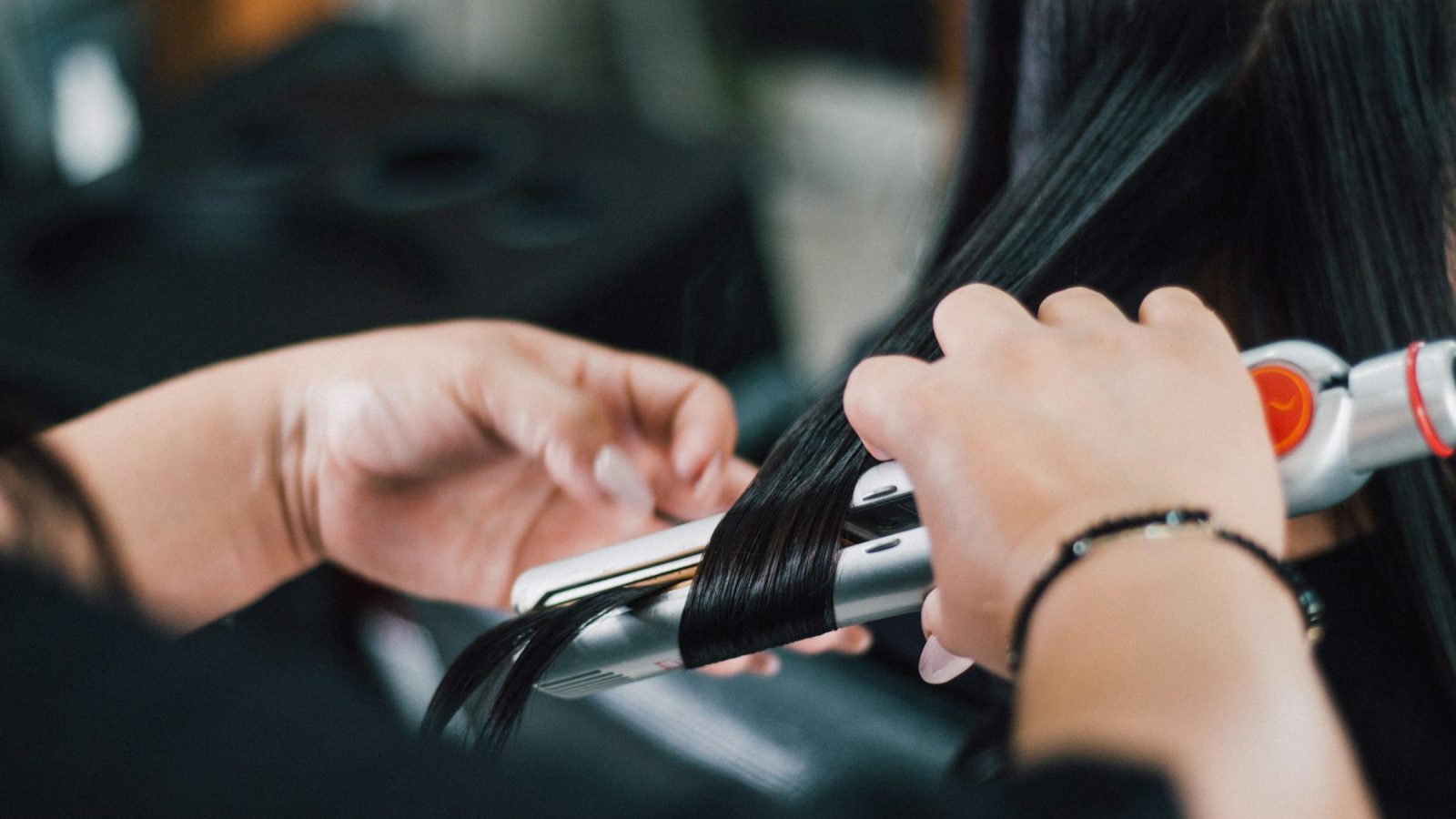
Blow-dryers, flat irons and curling irons run hot enough to change hair at the molecular level, and the damage adds up with every pass. A heat protectant helps, but only when it suits the tool and goes on the way its maker intends. This guide shows how to use heat protectant the right way: what heat does inside the strand, whether heat protectants work, damp vs dry application, layering with leave-ins and mousse, and what temperature to set.
Key takeaways
- Heat damage is measurable: cracked cuticles, lower water retention, broken-down keratin and more breakage. Heating wet hair can form steam bubbles inside the strand.
- Most heat protectants coat hair with film-forming polymers and/or silicones. Lab studies show they reduce damage, but they don’t make heat harmless.
- Blow-dry formulas go on damp, towel-dried hair; iron sprays go on dry hair. Never iron wet hair.
- Use the lowest temperature that holds the style. A 450°F rating is a ceiling, not a target.
What heat does to hair
Cuticle damage and moisture loss
Under an electron microscope, hair treated with a curling iron in dry conditions shows radial and lengthwise cracks and fused cuticle edges (Ruetsch and Kamath, 2004). With hair dryers, surface damage increased as drying temperature rose (Lee et al., 2011). Flat-ironed hair also regained and held less water afterward (Zhou et al., 2011).
Protein changes
Flat irons run above 392°F (200°C), hot enough to damage keratin. In flat-iron tests, researchers saw keratin shift from its normal α-helix structure to β-sheet and degrade, and heat-stressed hair broke significantly more when combed (Zhou et al., 2011). Another study measured virgin hair keratin denaturing at 459°F (237°C), just above the 450°F (232°C) top setting of the BaBylissPRO iron on our shelf (Lima et al., 2019). Lower heat still adds up: curling irons at 266–327°F (130–164°C) broke down the amino acid tryptophan over minutes of exposure, yellowed white hair, and yellowed and darkened bleached hair (McMullen and Jachowicz, 1998).
Bubble hair: why wet hair and hot tools don’t mix
Heat turns the water in hair into steam. Wet hair treated with a curling iron showed bubbling and buckled cuticle as steam escaped (Ruetsch and Kamath, 2004). Dermatologists call this bubble hair: brief, focal heating of damp hair forms bubbles inside the fiber, leaving it weak, dry and brittle (Gummer, 1994). In one report, an overheating hair dryer was the cause, and every volunteer’s hair bubbled once heated enough (Detwiler et al., 1994). Even hair that feels dry holds bound water: ten 5-second passes with a 455°F (235°C) flat iron produced bubbles and cracks in untreated hair (Essendoubi et al., 2022).
Most published cases involved a heated tool on wet hair and were managed by stopping that heat (Li et al., 2022). If a client has sudden breakage in a heat-styled area, suggest a dermatologist.
How heat protectants work, and whether they work
Most heat protectants coat the hair with film-forming polymers, silicones or both. On our shelf, Sebastian Trilliant lists VP/VA copolymer, polyquaternium-16 and dimethicone; Paul Mitchell Neuro Protect lists phenyl trimethicone and polyurethane-14; Olaplex’s blow-dry mist is silicone-free and uses polymers such as PVP. K18 describes a different approach: it says HeatBounce’s resilicore technology, inspired by the heat-tolerant protein resilin, reaches into the cortex instead of only coating the cuticle.
A 2025 dermatology review describes silicones as a thin film that reduces friction and mechanical stress during combing and heat styling and helps prevent moisture loss. It also notes that water-insoluble silicones can build up, so plan a clarifying shampoo (Carvalho et al., 2025). In flat-iron tests, selected polymers protected keratin in the cortex, kept the cuticle smoother, helped hair hold water and significantly reduced breakage (Zhou et al., 2011).
Do heat protectants work?
Yes, partly. Hair pretreated with a cationic polymer, a wheat protein or a conditioning agent lost 10–20% less tryptophan after 4–12 minutes of curling-iron heat at 270–306°F (132–152°C), and the polymer and conditioning agent kept combing forces from rising (McMullen and Jachowicz, 1998). Conditioners improved fiber durability in curling-iron tests (Ruetsch and Kamath, 2004), and one finished leave-in left fewer bubbles and cracks at 455°F (235°C) (Essendoubi et al., 2022).
The limits: these are lab tests on hair swatches, several run by ingredient suppliers or a brand, and the temperature ratings on bottles are the makers’ own claims. Heat protectants reduce damage; they don’t cancel it. Temperature, time and the number of passes still count.
Damp or dry? Match the product to the tool
Blow-dry formulas are made for damp, towel-dried hair; iron sprays are made for dry hair. Here is what each maker says about the heat protectants we carry.

| Product | Form | When to apply (maker’s directions) | Maker’s heat claim |
|---|---|---|---|
| K18 HeatBounce | Leave-in heat protectant | Towel-dried hair before blow-drying; dry hair before hot tools; every time heat is applied | Up to 450°F (232°C), tested with a flat iron on dry hair |
| Paul Mitchell Neuro Protect HeatCTRL Iron Hairspray | Hairspray | Dry hair before a hot iron; reapply to finish | Up to 450°F (232°C) |
| Sebastian Trilliant | Shine spray | Shake, apply to damp hair; for use with hot tools | Heat protection; no temperature listed |
| AG Care Firewall | Argan oil shine spray | Light mist before heat, or to finish | Up to 425°F (218°C) |
| CHI Keratin Silk Infusion | Leave-in treatment | Small amount on towel-dried hair or before blow-drying | Lists thermal protection; no temperature listed |
| Kenra Platinum Blow-Dry Spray | Blow-dry spray | Damp hair in sections, comb through, blow-dry | Up to 450°F (232°C) |
| Joico Dream Blowout Glass | Heat-activated spray | Liberally on clean, damp hair, comb through, blow-dry with tension | Up to 400°F (204°C) |
| Olaplex Volumizing Blow Dry Mist | Volumizing mist | Clean, damp hair in sections before blow-drying | Up to 450°F (232°C) |
| Color Wow Dream Coat | Heat-activated anti-frizz spray | Damp (not soaking) hair; saturate each section, comb, blow-dry with tension | Heat protectant; no temperature listed |
Ratings run from 400°F to 450°F, and three makers list none, so the product, not the tool, sets your ceiling. Amounts vary too: K18 says “less is more,” Joico says to spray liberally and Color Wow says to saturate. Follow the label.
How to use heat protectant, step by step
- Start clean and apply any leave-in treatment first.
- Blot to damp, not dripping. Color Wow’s target: not soaking wet, not dry.
- Section. K18, Kenra and Olaplex say to apply in sections; Color Wow suggests 4 sections for fine or medium hair and up to 6 for thick or long hair.
- Apply the maker’s amount to each section, top and underneath.
- Comb through gently. Kenra, Joico and Color Wow say to comb through; K18 says to brush through. The AAD notes that wet hair breaks more easily when combed.
- Blow-dry each section completely, keeping the dryer moving.
- Never iron wet hair. The AAD says flat irons belong on dry hair. Steam or sizzling means water is still there.
- Iron sprays go on dry hair, as Paul Mitchell directs for Neuro Protect.
- Reapply for each round of heat. K18 says to apply HeatBounce every time heat is applied, including when switching from dryer to hot tools. For touch-ups, use a product made for dry hair.
Layering with leave-ins, mousse and oils
Makers that give an order put treatment first, heat protection next and stylers after:
- K18: leave-in repair mask for 4 minutes, HeatBounce, volume spray, then blow-dry; HeatBounce again before hot tools; oil to finish. For how that mask compares, see Olaplex vs K18.
- Kenra: Platinum Blow-Dry Spray, then a curl enhancer before diffusing.
- Color Wow: a Dream Cocktail leave-in may go on first; nothing else before the blow-dry, and no second heat protectant.
- Joico: no other stylers until the Dream Blowout Glass blowout is finished.
So heat protectant goes before mousse, unless its maker says to use it alone. And oils? Moroccanoil says Moroccanoil Treatment helps protect against thermal damage but points to a dedicated heat protectant for more protection (see Moroccanoil Treatment Original vs Light). For aftercare on heat-styled hair, read protein vs moisture.
What temperature should you use?
Dermatologists keep it simple: use the lowest setting that gives the style you want. The American Academy of Dermatology (AAD) advises flat irons on dry hair at a low or medium setting, no more often than every other day, and notes that thicker, coarser hair may need a higher temperature. As a starting point, here is the hair-type chart BaBylissPRO prints for one of its digital curling irons (model BGT4NUC). Your own tool’s manual comes first.
| Hair type (BaBylissPRO chart) | Suggested setting |
|---|---|
| Fragile, very fine | 265–300°F (130–150°C) |
| Thin, easy to curl | 320–340°F (160–170°C) |
| Normal texture | 355–375°F (180–190°C) |
| Wavy or curly | 395–410°F (200–210°C) |
| Coarse, very thick | 410–430°F (210–220°C) |
Start at the low end, especially on lightened or fragile hair, and go up only if the style won’t hold.

Tool limits vs product ratings
BaBylissPRO lists settings up to 450°F for the BNT125S and says to adjust the heat to hair texture and type. Skip its Turbo Heat boost on fine or lightened hair. A product’s rating is the most heat its maker claims it covers, not a recommended setting: with a product rated to 400°F, keep the iron at or below 400°F. Color Wow adds: above 390°F (200°C), keep the iron moving and avoid long contact with any one section.
Blow-dryers count too
In a study that dried hair tresses 30 times, surface damage rose with temperature, which reached 203°F (95°C) with the dryer about 2 inches (5 cm) away. A dryer kept moving about 6 inches (15 cm) away was the gentlest option overall, even compared with air-drying (Lee et al., 2011). The GA.MA iQ Sfera dryer has 4 heat settings, 3 speeds and a cool shot, so you can lean on airflow instead of maximum heat.
Shop heat protectants and hot tools at OBB
We carry these at our Westminster store:
- Before blow-drying: K18 HeatBounce Conditioning Heat Protectant, Kenra Professional Platinum Blow-Dry Spray, Olaplex Volumizing Blow Dry Mist, Joico Dream Blowout Glass 72HR Frizz Fighter and Color Wow Dream Coat Supernatural Spray (travel size)
- Before irons: Paul Mitchell Neuro Protect HeatCTRL Iron Hairspray, AG Care Firewall Argan Shine & Flat Iron Spray and Sebastian Professional Trilliant Shine & Heat Protection Spray
- Leave-ins and finish: CHI Keratin Silk Infusion, Color Wow Dream Cocktail Carb-Infused and K18 Molecular Repair Hair Oil
- Tools: BaBylissPRO Nano Titanium 1¼″ Spring Curling Iron (BNT125S), GA.MA Professional iQ Sfera hair dryer, Wet Brush Pro Paddle Detangler and Colortrak croc clips for sectioning
Browse Styling & Heat Protection and Salon Tools & Supplies, or call or text (949) 591-5304 with your list and we will confirm stock and pricing. Setting up a station? See our hair salon supply checklist.
FAQ
Do heat protectants actually work?
Yes, within limits. In lab studies they reduce protein breakdown, surface damage and breakage from hot tools, but none makes high heat harmless.
Should heat protectant go on wet or dry hair?
Follow the product. Blow-dry formulas such as K18 HeatBounce, Kenra Platinum Blow-Dry Spray and Olaplex’s mist go on damp, towel-dried hair. Iron sprays such as Paul Mitchell Neuro Protect go on dry hair. Never flat-iron or curl wet hair.
Does heat protectant go before or after mousse?
Before, in routines where makers give an order: leave-in treatment, then heat protectant, then mousse or volumizer. Joico Dream Blowout Glass and Color Wow Dream Coat go on without other stylers before the blowout.
Can hairspray work as a heat protectant?
Only if its label claims heat protection, as Paul Mitchell Neuro Protect does (up to 450°F). Most hairsprays are made for hold and shine; see our hairspray hold guide.
Sources
- American Academy of Dermatology, Hair styling without damage and Black hair: Tips for everyday care
- Journal of Cosmetic Science: Zhou et al. 2011; McMullen and Jachowicz 1998, part I and part II; Ruetsch and Kamath 2004
- Journal of Cosmetic Dermatology, Lima et al. 2019; Annals of Dermatology, Lee et al. 2011
- British Journal of Dermatology, Gummer 1994; Journal of the American Academy of Dermatology, Detwiler et al. 1994; International Journal of Dermatology, Li et al. 2022
- International Journal of Cosmetic Science, Essendoubi et al. 2022; Skin Appendage Disorders, Carvalho et al. 2025
- K18, HeatBounce, claim notes and how to use; Paul Mitchell, Neuro Protect; Sebastian Professional, Trilliant; AG Care, Firewall; CHI, Keratin Silk Infusion
- Kenra Professional, Blow-Dry Spray; Joico, Dream Blowout Glass; OLAPLEX, Volumizing Blow Dry Mist; Color Wow, Dream Coat and Dream Coat Q&A; Moroccanoil UK, Treatment Original FAQ
- BaBylissPRO, BNT125S and BGT4NUC manual (PDF); GA.MA Professional, iQ Sfera
This article is general education for licensed professionals. Always follow the instructions that come with the product you are using.