

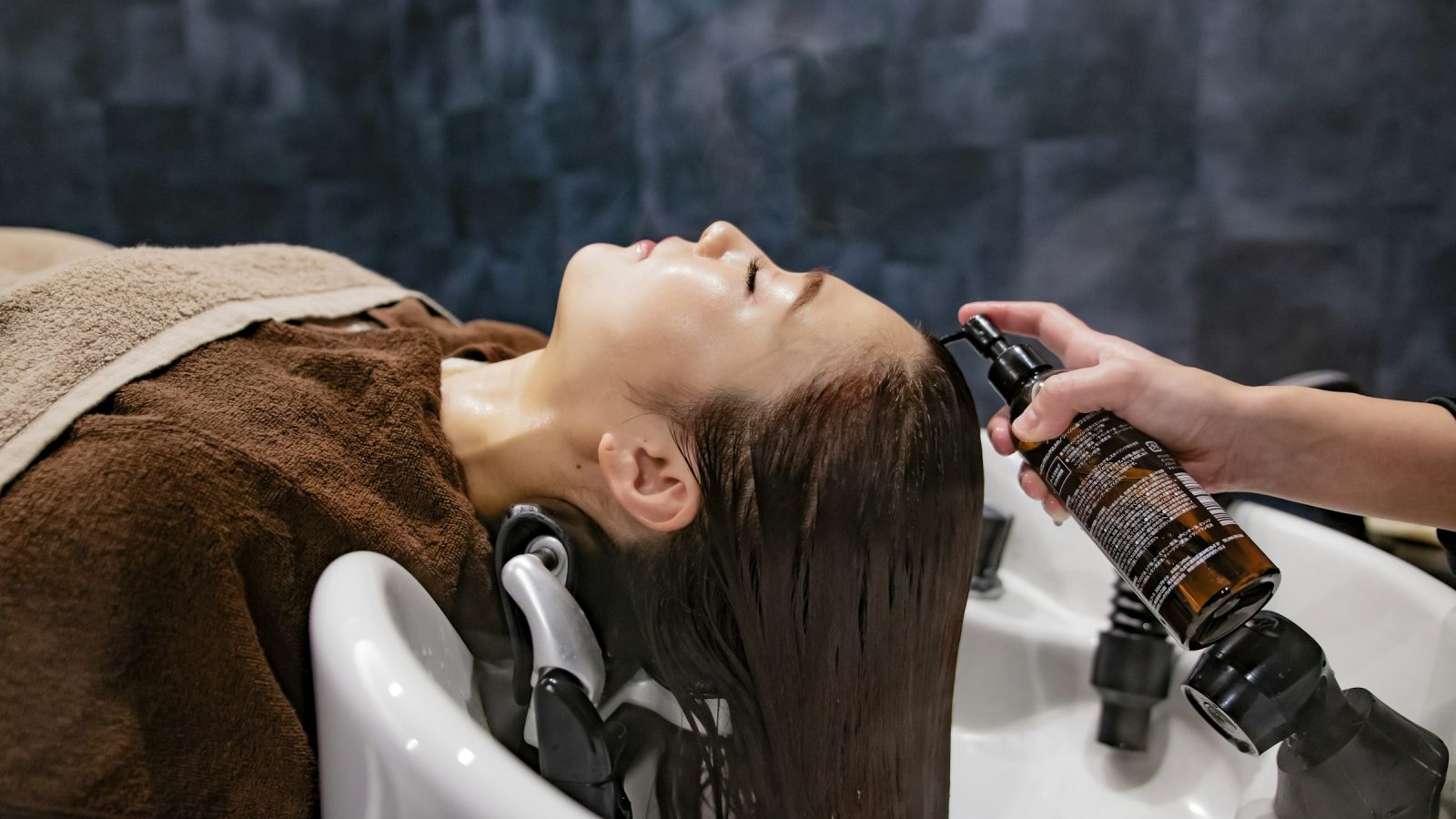
A client sits down with hair that feels wrong: gummy and stretchy after lightening, rough and snapping at the ends, or stiff after weeks of “repair” products. Very often the question is protein vs moisture. The hair needs strength, or it needs softness and slip, and giving it the wrong one makes things worse. This protein vs moisture hair guide for stylists and colorists covers how hair is built, how to read the wet stretch test, what “overload” really means, where bond builders fit, and which treatments to use.
Key takeaways
- Hair is mostly keratin protein, and it always holds water: about 10% of its weight at 40% humidity and about 31% at 100%.
- Protein products help weak, overly stretchy hair. Moisture products help dry, rough, stiff hair. Many products do some of both.
- The wet stretch test is a quick clue, not a diagnosis: springs back (balanced), stays stretched (needs strength), snaps (usually needs moisture).
- “Protein overload” and “hygral fatigue” are real terms, but the science behind them is thinner than social media suggests.
- Bond builders such as Olaplex are not protein treatments.
What hair is made of, and what damage changes
Proteins make up roughly 65 to 95% of a hair’s weight, mainly keratin (Fernandes et al., 2023). Two layers matter most:
- Cuticle: about 6 to 10 layers of flat, overlapping cells, like roof shingles. Its surface carries a fatty layer, 18-MEA, that keeps healthy hair water-repellent and slippery.
- Cortex: about 90% of the hair’s weight. Keratin chains linked by disulfide bonds give strength, and the coiled shape of the chains gives elasticity.
Water is part of hair
Reference data from hair scientist Clarence Robbins, summarized by chemist Michelle Wong, PhD, show hair holding about 10% of its weight in water at 40% relative humidity and about 31% at 100%. Water swells the fiber and temporarily breaks hydrogen bonds. Olaplex’s professional training manual notes that these bonds, which water and heat break and re-form, account for about a third of hair’s strength and half of its elasticity. That is why wet hair stretches more and needs gentle handling.
What damage does
Bleaching disrupts disulfide bonds and makes the cuticle more porous, lowering tensile strength. Rough washing, unprotected drying, friction, sun and alkaline chemicals wear away the fatty surface layer, so hair becomes more water-loving and negatively charged (Dias, 2015). It then swells more when wet, turns fragile and tangles easily. Blow-drying damage also grows as the temperature rises. Because hair is dead tissue, it cannot heal itself; products can only coat, fill and smooth it.
What protein and moisture products actually do
Moisture means the water held in the fiber plus ingredients that keep hair soft and flexible: humectants such as glycerin and hyaluronic acid, oils and butters, and cationic conditioners. Damaged hair carries a negative charge, so positively charged conditioners cling to it and leave a thin film that flattens the cuticle and adds softness and shine. Conditioners do not waterproof hair, though; they deposit in patches.
Protein treatments use hydrolyzed proteins, peptides or amino acids. Fragments of roughly 1 to 10 kDa can get inside the hair and bind to keratin, while large ones mostly stay on the surface. In a 2021 study on relaxed textured hair, mid-size and large keratin peptides made fibers stiffer and reduced breakage, and the largest formed a film on the surface (Malinauskyte et al., 2021). Stiffer is the goal when hair is gummy. It is the problem when hair is already rigid.
Labels overlap. Joico’s Moisture Recovery Conditioner releases keratin along with rosehip oil, and amika says its the kure mask strengthens and moisturizes. Go by what each maker says a product is for, then match it to the hair.
Signs hair needs protein vs moisture
Redken’s guide to dry versus damaged hair sorts it like this:
| Condition | What you see and feel | Start with |
|---|---|---|
| Dry | Dull, frizzy, static, rough or straw-like; tangles easily; wet strands feel stiff and barely stretch | Moisture |
| Weak or damaged | Gummy or mushy when wet; stretches without springing back; split ends, breakage; dries very fast | Strength (protein), plus bond care during chemical services |
| Dry and damaged | Brittle, breaking, straw-like, very porous; color and moisture don’t last | Alternate strength and moisture |
The wet stretch test, step by step
- Work on clean, wet hair so leave-ins don’t skew the result.
- Take single strands from four areas, such as the front hairline, temple, crown and nape.
- Hold each strand near the root end, stretch it gently, then let go.
Pull gently. Cosmetology training describes healthy wet hair as stretching up to about 50% of its length and returning (CHI Education), while lab work summarized by Dias (2015) found permanent changes can begin past about 30%.
- Stretches a little and springs back: balanced. Keep the routine.
- Stretches a lot, stays stretched, feels gummy: weak, over-softened hair, common after lightening. Reach for strength: a protein reconstructor or strengthening mask.
- Barely stretches, feels stiff, snaps: usually dry. Add moisture and retest after a few washes. If it still snaps easily, treat it as damage.
Test clean, wet single strands from four areas of the head. Pull gently: you are checking spring, not trying to break the hair.
A clue, not a diagnosis. Sources: CHI Education, Redken · Oh Baby Nails & Hair · obbnails.com
Know the limits of home tests
- A clue, not a diagnosis. Even Redken’s own guides read a quick snap two ways, as dehydration in one and damage in another. Weigh the result with the hair’s feel and service history.
- Roots and ends differ. Damage builds from root to tip, so test the ends too.
- Skip the float test. A hair dropped in water does not measure porosity. Michelle Wong explains that it mostly reflects surface damage and surface tension, and asks hairdressers not to use it to time chemical services; test the actual product on a strand instead. For a porosity read, slide dry strands between your fingers from ends to scalp: smooth means resistant, rough means porous (CHI Education).
Protein overload and moisture overload: what the terms mean
Protein overload
This is a salon term, not a diagnosis. Croda, a major supplier of hair care proteins, says proteins at normal use levels do not typically make hair stiff, because deposition levels off. With very high concentrations, as in some intensive treatments, excess protein can stay on and inside the hair and leave it rigid and brittle. If hair turns stiff and straw-like after a run of strengthening products, pause protein, clarify any buildup, use a moisture mask and retest.
Moisture overload and hygral fatigue
“Moisture overload” describes limp, mushy, overly stretchy hair that won’t hold a style. It is often blamed on hygral fatigue, the idea that repeated swelling and drying wears hair down. A 2015 review in the International Journal of Trichology calls hygral fatigue a factor that can damage hair. Michelle Wong counters that there is little convincing evidence: water breaks hydrogen bonds that re-form when hair dries, so water moving in and out does not cause damage by itself. Wong does agree that wet hair is more fragile. In practice, mushy hair usually points to damage: strengthen it and detangle gently rather than piling on conditioner.
Where bond builders fit
Bond builders are a third lane. Olaplex’s patented ingredient, bis-aminopropyl diglycol dimaleate, is designed to re-link broken disulfide bonds, and its training manual says Nº.3 Hair Perfector “is not a protein treatment or a hydrating mask.” K18 describes its K18Peptide as fitting into the keratin structure to reconnect broken polypeptide chains and disulfide bonds. Bond care does not replace protein or moisture, and damaged hair often needs all three. Compare the two brands in our Olaplex vs K18 guide.
Routine table: what to use and how often
Products are described as their makers describe them. Timing follows each maker’s directions; where none is given, let the stretch test decide.
| Hair condition | What to use | How often |
|---|---|---|
| Balanced, or dry | Joico Moisture Recovery Moisturizing Conditioner for dry hair, 1 to 2 minutes | Every wash |
| Dry, fine to medium, goes flat | Olaplex Weightless Nourishing Mask (lightweight hydration, labeled protein-free); amika hydro rush leave-in with hyaluronic acid and squalane | Mask weekly in place of conditioner; leave-in on towel-dried hair |
| Dry, medium to thick or coarse | Moroccanoil Intense Hydrating Mask, 5 to 7 minutes; Wella Invigo Nutri-Enrich Deep Nourishing Mask for dry or stressed hair, 5 minutes | Moroccanoil: 1 to 2 times a week |
| Dry and frizzy, including waves, curls and coils | Mizani 25 Miracle Milk leave-in; Matrix Food For Soft Hydrating Shampoo and Multi-Use Hair Oil Serum | Mizani: as needed; Matrix shampoo: can be used daily |
| Gummy, overly stretchy, weak after chemical services | Joico K-PAK Reconstructor (keratin and amino acids, at least 5 minutes); Wella Fusion Intense Repair Mask (silk amino acids and lipids, 5 minutes); Keratin Complex Keratin Obsessed keratin leave-in spray | As needed; retest after a few washes |
| Dry and damaged | amika the kure intense strength repair mask, 10 minutes; Sebastian Penetraitt Rescue Repair Conditioner for overprocessed hair | amika: weekly; Penetraitt: every wash |
| Stiff after lots of protein | Pause protein, clarify if needed, then a moisture mask | Next wash, then retest |
In the salon: color, lightening, clarifying and heat
After lightening or color. Protect bonds during the service, then read the hair once rinsed. Gummy hair needs strength before softness. Joico’s professional K-PAK Hair Repair System shows the order: clarify, seal the cuticle, reconstruct for 5 minutes, then hydrate. For lightener choices, see powder vs cream lightener, and when a treatment is part of a color appointment, the 48-hour allergy alert test still comes first.
Clarify when there is buildup. Joico’s system starts with a clarifying shampoo to remove chlorine, minerals and product buildup, and Olaplex’s perm steps include clarifying before the service. Clarify coated hair, then treat. See our clarifying shampoo guide.
Heat styling. Treatments cannot undo heat damage, so protect first; see how to use heat protectant. Mizani says 25 Miracle Milk protects up to 450°F (232°C), and Matrix says the same of its Food For Soft oil serum.
Shop protein and moisture treatments at OBB

We carry strength and moisture treatments from professional lines in our Westminster store, including:
- Strength: Joico K-PAK Reconstructor, Wella Fusion Intense Repair Mask, Keratin Complex Keratin Obsessed
- Strength plus moisture: amika the kure mask, Sebastian Penetraitt
- Moisture: Moroccanoil Intense Hydrating Mask, Wella Invigo Nutri-Enrich, Olaplex Weightless Nourishing Mask, Joico Moisture Recovery, Matrix Food For Soft Shampoo and Oil Serum
- Leave-ins: Mizani 25 Miracle Milk, amika hydro rush
Browse everything in Hair Care, or call or text (949) 591-5304 with your list and we will confirm stock and pricing.
FAQ
How can you tell if hair needs protein or moisture?
Combine feel with the wet stretch test. Rough hair that barely stretches usually needs moisture; gummy hair that stays stretched needs strength; brittle, breaking hair often needs both, alternated.
What does protein overload look like?
Stiff, rough, straw-like hair that may snap after intensive strengthening products. Pause protein, clarify and add moisture.
How often should you do a protein treatment?
There is no single schedule. amika recommends the kure mask weekly; the Joico K-PAK Reconstructor and Wella Fusion mask pages give no fixed frequency. Let the stretch test decide.
Is Olaplex a protein treatment?
No. It is a bond builder, and its Weightless Nourishing Mask is labeled protein-free.
Sources
- Polymers (MDPI), Fernandes et al. 2023, On Hair Care Physicochemistry
- International Journal of Trichology, Dias 2015, Hair Cosmetics: An Overview
- International Journal of Cosmetic Science, Malinauskyte et al. 2021, Penetration of different molecular weight hydrolysed keratins into hair fibres
- Croda Beauty, Protein myths, debunked
- Lab Muffin Beauty Science, Hair porosity tests are a lie and The myth of hygral fatigue
- CHI Education, Hair and Scalp Analysis
- Redken, How to Tell if Hair is Dry or Damaged and Hydrated Hair
- OLAPLEX, Professional Training Manual (PDF) and Weightless Nourishing Mask
- K18, Our science
- Joico, K-PAK
This article is general education for licensed professionals. Always follow the instructions that come with the product you are using.