

Towels usually smell musty because they stayed damp too long, in a hamper, on a hook or in the washer, or because detergent residue and a dirty washer let odor-causing buildup grow. Rewash them as the care label allows, dry them completely right away, and clean the washer. Here’s what the American Cleaning Institute (ACI), washer maker Whirlpool, a university extension service, Poison Control and California’s salon rules say.
Key takeaways
- Hang towels to dry between uses and wash them after 3 to 5 uses (ACI).
- Use the detergent amount on the label and don’t overload the washer (ACI). Take laundry out as soon as the cycle ends; Whirlpool says wet laundry left in the washer can mildew.
- Run a clean-washer cycle monthly and leave the door open between loads (Whirlpool).
- Never mix bleach with vinegar, ammonia or other cleaners. Poison Control warns that bleach plus ammonia or an acid such as vinegar makes toxic gas.
- Scent boosters add fragrance. Only EPA-registered products can claim to kill germs (ACI).
- California salons must launder towels commercially or in water of at least 160°F for 25 minutes (16 CCR § 987).
Why do towels smell musty?
- They stay damp. A musty odor is usually how you notice mold, says North Dakota State University (NDSU) Extension, and laundry rooms with damp towels and clothing are a common place for it. On damp materials, mold can grow within about two days.
- They sit wet in the washer. Whirlpool says wet laundry left in the drum can lead to mildew, which can cause odors in both the laundry and the washer.
- Too much detergent or softener. ACI says too much or too little detergent can leave laundry less clean. Whirlpool warns that more than the recommended amount can make detergent and soil residue build up faster inside the washer, which may cause odor. Too much softener can leave residue, too.
- A packed washer. Overloading can keep laundry from getting clean (ACI). In a front-loader, ACI says your hand should fit upright between the laundry and the top of the drum; in a top-loader, don’t pile clothes above the agitator, or past about two-thirds full without one.
- A dirty washer. ACI’s guide to high-efficiency washers says cool washes and excess suds can leave oily and dirt-type soils in the machine, where over time they can lead to bacteria, mold and odors.
How to get the musty smell out of towels
- Read the care label. It sets the hottest water and the type of bleach the towel can take (ACI). Test any bleach or stain product on a hidden spot first.
- Rewash with the right dose. Measure detergent for the load size, as the label directs, and use the hottest water the care label allows. ACI says the Normal/Cotton cycle, with warm or hot water, suits towels.
- Leave room. Wash a smaller load (ACI).
- Add a bleach or sanitizer the label allows, as its directions say. ACI says chlorine bleach disinfects as well as cleans and whitens, and works on many whites and colorfast washables but not wool or silk. For colors, a color-safe (oxygen) bleach can help remove stains and odors, but ACI notes that detergents with built-in color-safe bleach don’t disinfect. An EPA-registered laundry sanitizer is another option (ACI).
- Dry right away and completely (below).
One product at a time. Poison Control warns that bleach mixed with ammonia makes chloramine gas, and bleach mixed with an acid, including vinegar, makes chlorine gas. Never add vinegar or another cleaner to a bleach wash. It also advises gloves and good ventilation when you use bleach. If fumes make you cough or your eyes burn, leave the area and get fresh air; Poison Control is at 1-800-222-1222.
Go easy on softener. Sources disagree here. ACI says the right amount of fabric softener won’t make towels less absorbent. Whirlpool says to skip softener on towels when you want maximum absorbency, because softeners can reduce it. Either way, don’t use more than the label says.
How to dry towels so they stay fresh
- Hang each towel to dry between uses. ACI says towels need to dry before they’re used again and should be washed after 3 to 5 normal uses.
- Don’t leave damp towels balled up in a hamper or gym bag. NDSU says to store clothing dry and clean to prevent mold.
- Tumble dry as the care label allows, and only fold and store towels once they’re fully dry (ACI).
- Clean the dryer’s lint screen after each load, and don’t overload the dryer either (ACI).
- For mildewed towels, NDSU suggests brushing, shaking and airing them outdoors in the sun, then laundering washable items with detergent, and chlorine bleach when appropriate.
How to clean a washing machine that smells
Follow your washer’s manual. Whirlpool’s advice for its washers:
- Run the Clean Washer cycle at least once a month or every 30 washes, whichever comes first, with an affresh washer cleaner tablet or liquid chlorine bleach.
- With bleach, Whirlpool’s directions call for 1 cup (236 mL) in the dispenser and warn that more can damage the washer over time. Add no detergent or other chemicals, and don’t use thickened or no-splash bleach in the affresh cycle.
- Leave the door or lid open between loads so the inside can dry.
- Clean the dispenser drawer regularly, as your manual directs.
- Use HE detergent in HE washers, never more than the recommended amount, and choose warm or hot washes some of the time, not only cold.
ACI’s washer guide calls this an empty “maintenance cycle” but gives a different bleach amount, so go by your manual.
Do fragrance boosters get rid of musty smells?
Scent boosters are small, water-soluble beads added to the washer drum before the laundry to add long-lasting fragrance, ACI explains. Purex says its Crystals scent boosters fight odors, and directs you to add them to the empty drum before your clothes and detergent, using the cap to measure how strong a scent you want.
Don’t count on a scent booster to kill germs. ACI says products that claim to kill germs must be registered with the EPA and carry an EPA registration number on the label, and the EPA lists laundry additives among its categories of sanitizers. If a booster’s label makes no such claim, it’s for scent. In salons, note that the American Academy of Dermatology (AAD) lists fragrance among the most common causes of allergic contact dermatitis.
Salon towels: California’s rules
Licensed salons, barbershops and schools follow the California Board of Barbering and Cosmetology’s health and safety rules in 16 CCR. Here is the text as published by Cornell’s Legal Information Institute.
Quoted from 16 CCR §§ 987, 985 and 990 (Cornell LII).
- § 987(a): “After a towel, sheet, robe, linen or smock has been used once, it shall be deposited in a closed container and not used until properly laundered and sanitized.”
- § 987(b): Towels, sheets, robes, linens and smocks “shall be laundered either by regular commercial laundering or by a noncommercial laundering process which includes immersion in water at least 160° F for not less than twenty-five (25) minutes during the washing or rinsing operation.” A commercial laundry may instead use chemicals and cold water if it follows the manufacturers’ instructions; its detergents need no antimicrobial claims.
- § 987(c): “All clean towels, sheets, robes, linens and smocks shall be stored in clean, closed cabinets or a clean, closed container.”
- § 985: “A sanitary neck strip or towel shall be used to keep the protective covering, such as client capes, from coming in direct contact with a client’s neck.”
- § 990(a): “The headrest of chairs shall be covered with a clean towel or paper sheet for each client.”
§ 987 doesn’t name capes; § 985 covers keeping them off the client’s neck. Check the Board for current rules.
What that means day to day:
- “Hot” may not be hot enough. ACI defines hot laundry water as 120°F to 140°F, below the rule’s 160°F. If you wash towels in-house, check your washer’s manual for the temperature and length of its hottest or sanitize cycle, or use a commercial laundry. CDC guidance for health-care laundries gives the same 160°F-for-25-minutes figure for hot-water washing.
- Don’t let the soiled bin sit. Used towels go in a closed container, and mold can start on damp materials within about two days (NDSU), so launder them promptly.
- Toss single-use items. Neck strips, cotton pads and other supplies that touch a client and can’t be disinfected go in the trash after one client (§ 981(a)).
- Color on towels? See our guide to hair dye stains on towels, carpet and counters.
At OBB
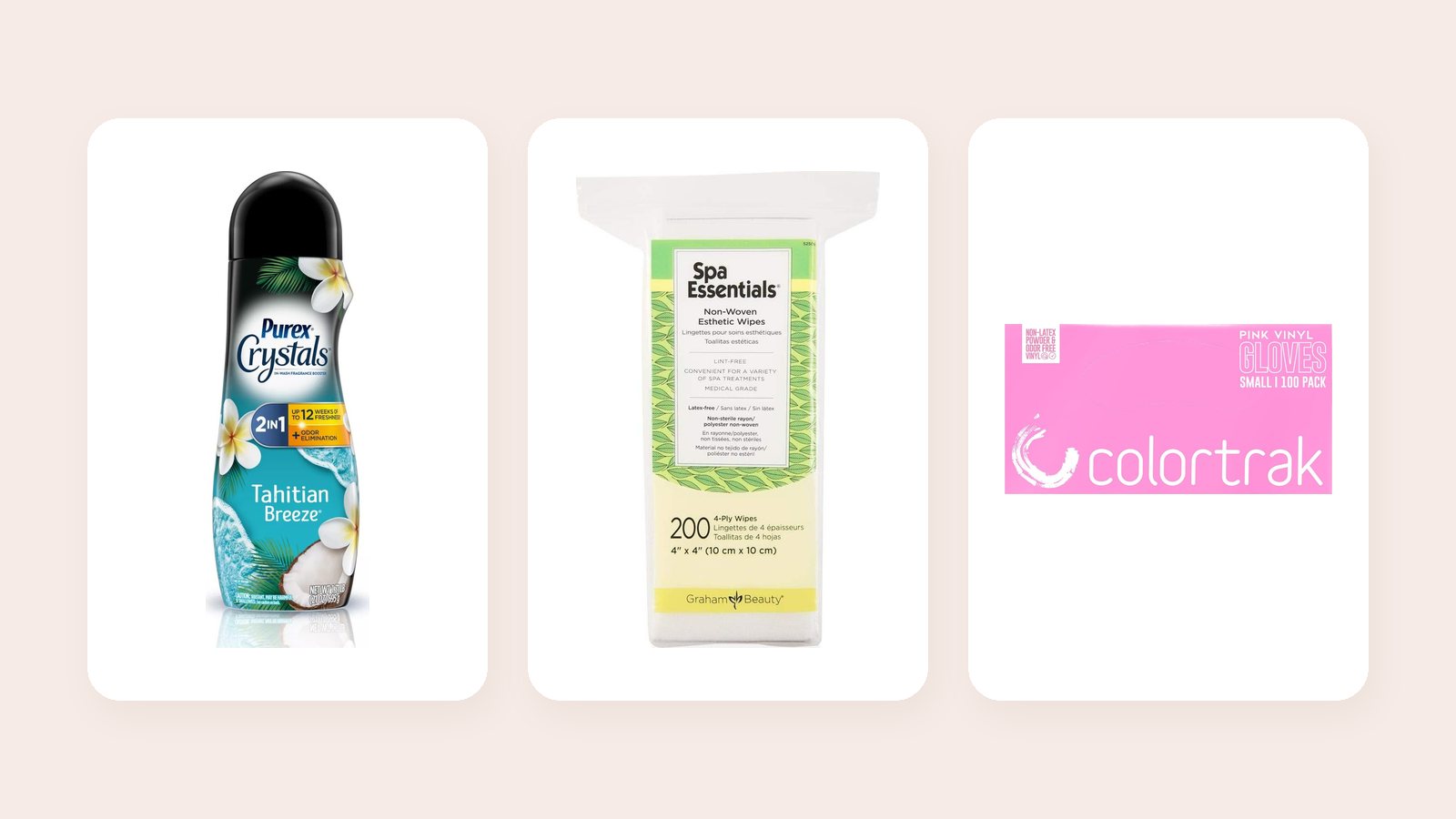
- Purex Crystals In-Wash Fragrance Booster, 2-in-1, Tahitian Breeze: in-wash scent crystals. Purex calls them a scent booster that fights odors, to be added to the empty drum before the laundry, and makes no germ-killing claim on its product page.
- Colortrak Pink Vinyl Disposable Gloves: Colortrak says they’re single-use, non-latex, powder-free gloves. Wear gloves whenever a bleach or cleaner label calls for them.
- Spa Essentials Non-Woven Esthetic Wipes, 4″ x 4″: Graham Beauty, the maker, describes a soft, highly absorbent nonwoven blend for cleansing skin during facials and before waxing. Throw each one away after use.
Call or text (949) 591-5304 with your list and we will confirm stock and pricing, then pick up at our Westminster store.
Related reading: hair dye stains on towels, carpet and counters, latex vs nitrile vs vinyl gloves and California pedicure spa cleaning rules.
FAQ
Why do my towels smell even after washing?
Usually they sat wet in the washer, got too much detergent or softener, were packed in too tightly, or the washer needs cleaning (Whirlpool, ACI). Rewash, dry them completely right away, and run a clean-washer cycle.
How often should you wash bath towels?
ACI says to hang them to dry between uses and wash them after 3 to 5 normal uses.
Can you use vinegar and bleach together?
No. Poison Control warns that bleach mixed with an acid such as vinegar makes chlorine gas. Use one product per wash.
Do scent boosters disinfect towels?
Not unless the label says so and carries an EPA registration number (ACI). ACI describes scent boosters as a way to add fragrance.
How hot must California salons wash towels?
Towels need regular commercial laundering, or a noncommercial process that immerses them in water of at least 160°F for at least 25 minutes. A commercial laundry may instead use chemicals and cold water if it follows the manufacturers’ instructions (16 CCR § 987(b)).
Sources
- American Cleaning Institute: Laundry Basics, Do I need to wash this?, How to Use Bleach, Fabric Softeners and Enhancers, Ask ACI: Laundry Load Size, Ask ACI: Kitchen Towel and Bath Towel Mix Up and High Efficiency Washers and Detergents (PDF)
- Whirlpool: Removing Odors from the Interior of a Washer, Removing Odors or Smells, Front Load Washer and Tips for Using Fabric Softener in Washer
- NDSU Extension, Molds in Your Home (AE1179, reviewed 2023); Poison Control, Chlorine gas
- US EPA, What are Antimicrobial Pesticides?; CDC, Laundry and Bedding (Guidelines for Environmental Infection Control in Health-Care Facilities); AAD, Contact dermatitis causes
- California Code of Regulations, Title 16 (Cornell LII): § 987 Towels, § 985 Neck Strips, § 990 Headrests, Shampoo Trays and Bowls, and Treatment Tables and § 981 Tools and Supplies
- Product pages: Purex Crystals scent boosters and Crystals directions, Colortrak Pink Vinyl Disposable Gloves and Graham Beauty Spa Essentials Esthetic Wipes
This is general cleaning information, not legal, medical or professional advice. Follow care labels and your washer’s and products’ directions first, test bleach on a hidden spot, never mix cleaning products, and check with the California Board of Barbering and Cosmetology for current salon rules.