

Treat hair dye stains right away. On fabric, blot off the extra color, flush the spot from the back with cool water, work in liquid laundry detergent, and keep the item out of the dryer until the stain is gone. On carpet and counters, blot instead of rubbing and start with mild dish soap. Test every product on a hidden spot first.
Key takeaways
- Act fast. The Carpet and Rug Institute warns that waiting can make a spill permanent.
- Blot, don’t rub, and test every product on a hidden spot first.
- Fabric: cool water from the back, liquid detergent, then only a bleach the care label allows. No dryer until the stain is gone.
- Never mix cleaners. Bleach plus ammonia or an acid such as vinegar makes toxic gas.
- Hair color remover wipes are made for skin, not fabric, carpet or counters.
Why hair dye stains set so fast
Hair color is designed to cling. The National Cancer Institute explains that permanent dyes contain colorless ingredients that react with hydrogen peroxide to form pigment molecules, while semi-permanent and temporary dyes contain colored compounds that stain directly. (See permanent vs demi vs semi-permanent color.)
Dye clings to fabric and carpet, too: the University of Georgia Extension says stains from agents designed to dye are extremely difficult to remove. Texas A&M AgriLife Extension adds two rules: treat stains quickly, since old stains may be impossible to remove, and keep heat away, since heat sets stains.
How to get hair dye out of towels and clothes
Read the care label first. Texas A&M says to take “dry clean” items to the cleaner as soon as possible and name the stain. For washable fabric, stop as soon as the stain is gone:
- Blot and scrape off extra dye. Don’t rub: the University of Kentucky Extension warns that rubbing can spread a stain and damage fibers.
- Flush from the back. Lay the stain face down on white paper towels and run cool water through the back, so the dye is pushed out instead of through.
- Pretreat and wash. Kentucky and Texas A&M both use heavy-duty liquid laundry detergent on dye stains. Work it in, rinse, then wash in warm water if the label allows.
- Check before drying. The American Cleaning Institute (ACI) says to repeat the steps if needed and keep the item out of the dryer until the stain is out.
- Use a bleach the label allows (below).
- Last resort for whites: a packaged color remover, used as directed. Texas A&M warns it removes the fabric’s own dye, too.
Bleach: read the label first
Under the FTC’s Care Labeling Rule, a label must say “Only non-chlorine bleach, when needed” if chlorine bleach would harm the item, and “No bleach” or “Do not bleach” if every bleach would.
- Chlorine bleach: whites and colorfast fabrics only, never wool, silk or spandex (Texas A&M, Kentucky).
- Oxygen (all-fabric) bleach: usually safe for all fabrics and colors except flame-retardant finishes, per Texas A&M. Kentucky tests it on a hidden spot first.
- Bleach the whole item. Bleaching one spot on a colored garment removes color unevenly, Texas A&M warns.
White and colored salon towels
For white towels, Clorox, a bleach maker, suggests this: submerge them for up to 5 minutes in 1/4 cup of its bleach per gallon of water, then wash in the hottest water the care label allows with detergent and 1/3 cup of bleach. Air-dry, check, and repeat rather than strengthen the soak. Test colored towels first: put one drop of 2 teaspoons bleach in 1/4 cup water on a hidden spot, wait 1 minute and blot (Texas A&M’s test mix is stronger, 1 tablespoon per 1/4 cup). If the color changes, Clorox suggests a color-safe stain remover.
How to get hair dye out of carpet and upholstery
The Carpet and Rug Institute (CRI) Spot Solver gives these steps for hair dye on carpet:
- Blot with a dry white cloth or white paper towels.
- Test each solution on a hidden spot for color transfer or damage.
- Put a little solution on a white cloth, not on the carpet. Work it in gently from the edges toward the center, wait a few minutes and blot. Don’t rub.
- Start with 1/4 teaspoon of liquid dishwashing detergent in 1 cup of lukewarm water, never stronger. Skip laundry detergent (optical brighteners can dye fibers) and dishwasher detergent (bleaching agents).
- Repeat while color transfers to the cloth. Then try 1 cup of white vinegar in 2 cups of water.
- Rinse with water and blot dry; CRI warns that detergent residue can make carpet soil quickly.
- Still stained? Call a professional; CRI says pros have the equipment for stronger solutions.
Two cautions: Georgia Extension advises against vinegar on cotton or linen rugs, and vinegar is an acid, so never follow it with bleach.
Upholstery and leather
Check the cleaning code on the furniture tag. Per La-Z-Boy’s care guide, W means water-based upholstery shampoo or foam, no solvents; S means water-free dry-cleaning solvent, no water; W-S allows either; X means vacuum or brush only.
On W or W-S fabric, blot, test, don’t soak the fabric, and clean from the outside toward the middle, as La-Z-Boy advises. For S or X fabric, call an upholstery cleaner. Georgia Extension says to wipe dye off vinyl at once with warm, sudsy water, and warns that dye stains leather for good on contact; La-Z-Boy recommends a leather cleaning pro for difficult stains.
Hair dye on countertops, sinks, tubs and grout
Wipe drips while wet, test a hidden spot, use one product at a time and rinse well. Then follow your surface maker’s advice:
- Laminate: Wilsonart warns that hair dyes can permanently stain its laminate; wipe spills immediately with dishwashing detergent or an all-purpose cleaner. Both makers also suggest a baking soda and water paste. For stubborn stains, Wilsonart allows undiluted household bleach or nail polish remover for up to 2 minutes, then a thorough rinse; Formica lists acetone, rubbing alcohol or ethanol. Neither wants acidic or abrasive cleaners.
- Quartz: Caesarstone recommends soap and water or a mild detergent, non-abrasive cleaners and a thorough rinse. It warns that long contact with any cleaning solution, or strong chemicals and solvents, can permanently damage its surfaces.
- Granite and marble: The Natural Stone Institute (NSI) says to blot, not wipe, then flush with water and mild soap, rinse and dry. It warns that vinegar and other acids can etch marble, and recommends a stone professional for stubborn stains.
- Sinks and tubs: Kohler says abrasive cleaners aren’t recommended on enameled cast iron. American Standard says to clean its acrylic tubs with a mild liquid detergent, never abrasive powders, and never to let nail polish remover, acetone or other solvents touch them.
- Tile grout: The Tile Council of North America (TCNA) says cement grout is porous and responds to the same cleaners you’d use on clothes, but acids such as vinegar dissolve cement. Laticrete says to wipe spills immediately, then scrub with warm water and a white nylon pad for at least 60 seconds.
Hair dye stain removal mistakes
- Never mix cleaners. Poison Control warns that bleach mixed with ammonia makes chloramine gas, and bleach mixed with an acid, such as vinegar or some toilet bowl cleaners, makes chlorine gas. Rinse one product out thoroughly before trying another, as Texas A&M advises.
- Don’t skip the test. Texas A&M suggests a hidden spot such as a seam allowance: apply, wait 2 to 5 minutes, rinse, and skip the product if color or texture changes.
- Don’t use remover wipes on fabric or counters. Framar and Colortrak describe their wipes for removing color from skin.
If fumes make your eyes, nose or throat burn, Poison Control says to leave the area and get fresh air. Call 1-800-222-1222, and get medical care for any trouble breathing.
How to prevent hair dye stains at home and in the salon
- Wear gloves. The FDA says to wear gloves when applying hair dye; Clairol suggests them for rinsing, too.
- Cover up. Clairol suggests a towel, plastic apron or old T-shirt, and towels or plastic bags on the floor. In the salon, use a cape.
- Use old towels. Garnier suggests an old towel clipped around the shoulders, and another that’s OK to stain for drying. Keep old or dark towels for color days.
- Protect the hairline. Garnier suggests a little petroleum jelly or conditioner along the hairline to prevent stains and drips; salons can use a barrier cream.
- Wipe as you go. Clairol says to wipe extra dye off the neck and forehead with a wet cloth while color processes. Wipe counter and sink drips, too.
- Seal grout. TCNA recommends sealing cement grout to prevent staining.
For color on skin, see how to get hair dye off skin.
At OBB
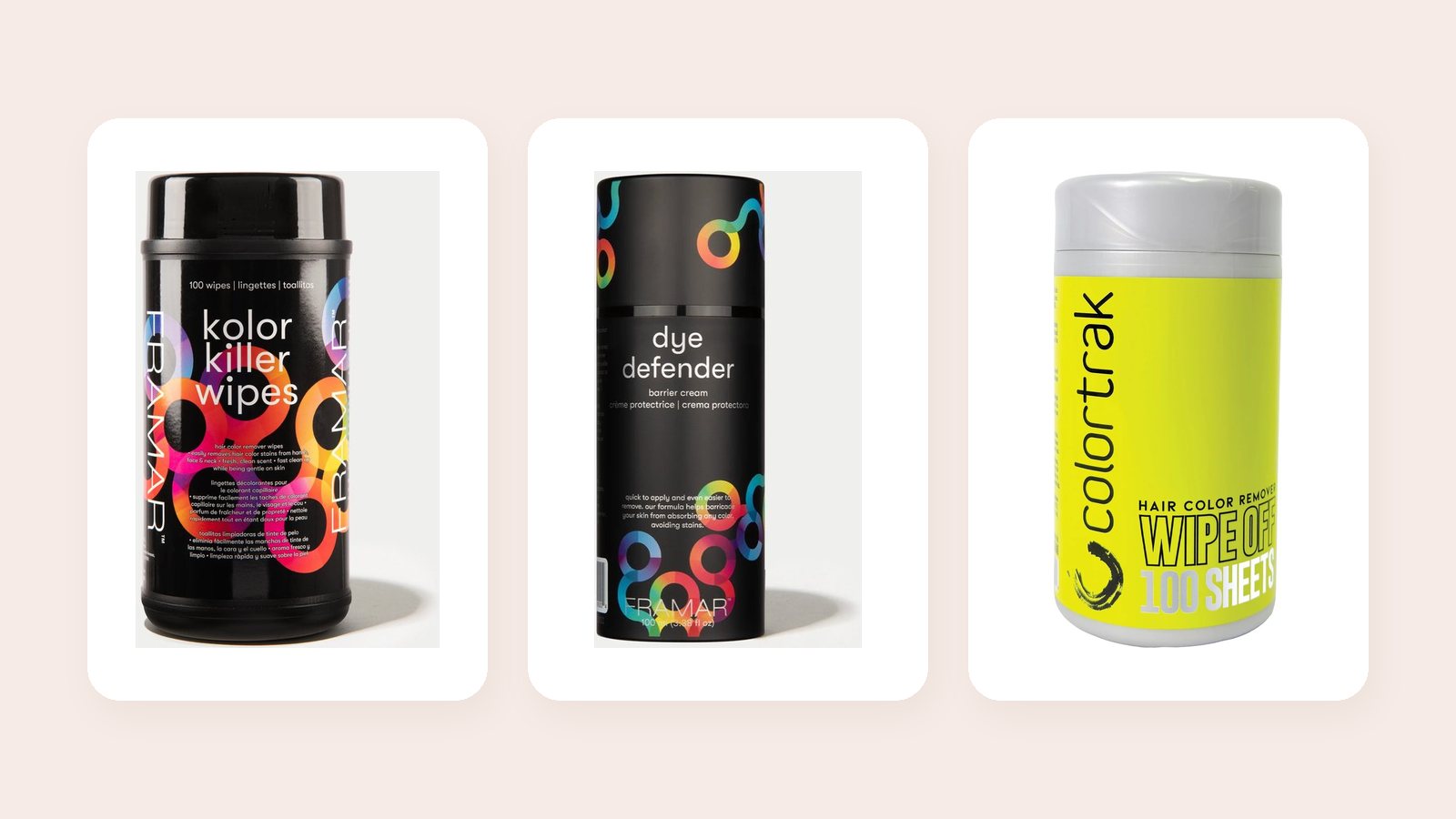
- Framar Dye Defender – Barrier Cream: Framar says it keeps hair color from sitting directly on the skin and washes off with just water. Apply it to the neck, ears and hairline before coloring, as Framar directs.
- Colortrak Pink Vinyl Disposable Gloves: single-use vinyl gloves, latex-free and powder-free.
- Gloves Latex, 1000 pcs/carton: latex gloves, 1,000 to a carton.
- Framar Kolor Killer Wipes: made to remove color stains from hands, face and neck. Skin only, not fabric or counters.
- Colortrak Wipe Off Hair Color Remover Wipes: Colortrak says they remove color stains from skin after a service and contain aloe. Also skin only.
Call or text (949) 591-5304 with your list and we will confirm stock and pricing, then pick up at our Westminster store.
Related reading: How to Get Hair Dye Off Skin, Hair Dye Allergy Test: 48-Hour Patch Test and Latex vs Nitrile vs Vinyl Gloves.
FAQ
Can you get hair dye out of towels?
Act fast: flush with cool water, work in liquid detergent and wash, with no dryer until the stain is gone. For white towels, Clorox suggests a short bleach soak and a hot wash. Texas A&M warns that old stains may be impossible to remove.
Does vinegar get hair dye out of carpet?
CRI lists a white vinegar solution (1 cup to 2 cups of water) as the step after a mild dish-detergent solution. Blot, rinse, and never combine it with bleach.
Will bleach remove hair dye from clothes?
It can, if the care label allows. Chlorine bleach is for whites and colorfast fabrics, oxygen bleach for the rest, and bleach never goes with ammonia or vinegar.
How do I get hair dye off a laminate countertop?
Wipe it up right away with dishwashing detergent or an all-purpose cleaner, as Wilsonart advises, then try a baking soda paste. For stubborn stains, follow your brand’s guide.
Do hair color remover wipes work on fabric?
They aren’t made for it: Framar and Colortrak describe their wipes for removing color from skin. Use the fabric steps above.
Sources
- American Cleaning Institute, Stain Removal Guide
- Texas A&M AgriLife Extension, Removing Stains from Washable Fabrics
- University of Kentucky Extension, Stain Removal for Washable Fabrics
- University of Georgia Extension, Dye stain removal
- Carpet and Rug Institute, Spot Solver: Hair Dye
- Federal Trade Commission, Care Labeling Rule guide
- National Cancer Institute, Hair Products and Cancer Risk
- Poison Control, Chlorine gas
- Clorox, How to Get Hair Dye Out of Towels
- La-Z-Boy, Fabric and Leather Care
- Wilsonart, Laminate Care & Maintenance; Formica, Cleaning Formica Products
- Caesarstone, Residential Care and Maintenance
- Natural Stone Institute, Care & Cleaning of Natural Stone and Marble countertop care
- Kohler, Enameled Cast Iron Sink Care; American Standard, acrylic bath care instructions
- Tile Council of North America, Cleaning Grout; Laticrete, Cement Grout Care
- FDA, Hair Dyes; Clairol, How to dye your hair at home and first-time dyeing tips; Garnier, How to Dye Your Hair at Home
- Framar, Kolor Killer Wipes; Colortrak, Wipe Off Hair Color Remover Wipes
This is general cleaning information, not professional or medical advice. Follow care labels and manufacturers’ instructions first, test a hidden spot, never mix cleaning products, and if fumes make you unwell, get fresh air and call Poison Control at 1-800-222-1222.