

Apply vitamin C serum to clean, dry skin after you wash your face and before moisturizer, and in the morning finish with sunscreen, because vitamin C is an antioxidant, not a sunscreen. If the serum has turned yellow, orange or brown, the vitamin C has likely oxidized: air, light and heat have started to break it down, research reviews and the maker IMAGE explain. Here is what the American Academy of Dermatology (AAD), Cleveland Clinic, the FDA and published reviews say about using it, storing it and avoiding irritation.
Key takeaways
- Vitamin C is an antioxidant. It doesn’t absorb UV light, so it can’t replace sunscreen (2013 review, Cleveland Clinic).
- Order: cleanse, pat dry, serum, moisturizer, then sunscreen in the morning (AAD, Cleveland Clinic).
- Use the amount your product’s directions give, and expect weeks to months before you see a change.
- Yellow, orange or brown usually means oxidized. Keep the cap closed and the bottle away from light and heat (IMAGE, Cleveland Clinic).
- Test a new serum on a small patch first, and stop if your skin turns red, itchy or swollen (AAD).
What does vitamin C serum do, and what can’t it do?
Vitamin C (L-ascorbic acid) is the most abundant antioxidant in human skin, according to a 2017 review in the Journal of Clinical and Aesthetic Dermatology. Antioxidants neutralize free radicals, unstable molecules created by UV light and air pollution, Cleveland Clinic explains. One of its dermatologists says there is good scientific evidence that vitamin C has antioxidant effects, and Cleveland Clinic says applying it is the best way to get its skin benefits. A 2017 review in the journal Nutrients adds a caveat: if your blood levels are already saturated, applying vitamin C may not raise the amount in your skin.
Keep your expectations modest:
- The research is limited. The 2017 dermatology review says clinical studies of topical vitamin C remain limited, and the human trials it describes were small. The Nutrients review calls the evidence for fewer wrinkles “less than convincing.”
- Dark spots: the AAD’s guide to dark spots in darker skin tones lists vitamin C among ingredients in nonprescription products that can fade them, but says treatment begins with sunscreen. The dermatology review notes that vitamin C may not work as well as hydroquinone on pigment.
- Not a sunscreen: vitamin C doesn’t absorb UV light, a 2013 review in the Indian Dermatology Online Journal explains, so it should be used with sunscreen. A Cleveland Clinic dermatologist says a vitamin C serum reinforces sunscreen but doesn’t replace it. The FDA regulates sunscreens, including SPF moisturizers, as drugs; a serum without SPF isn’t sun protection.
- Strength and form vary. Cleveland Clinic suggests 10% to 20% L-ascorbic acid: less may do little, and more than 20% risks irritation. Neither IMAGE nor Murad lists a percentage on the product pages we checked. Experts disagree about more stable derivatives: one Cleveland Clinic dermatologist says only L-ascorbic acid is useful, while the 2013 review calls magnesium ascorbyl phosphate useful.
How to apply vitamin C serum: order and amount
- Wash your face and pat it dry. IMAGE says to apply its serum to clean, dry skin.
- Apply the amount your product’s directions give. IMAGE says 1 to 2 pumps over the face, neck and chest. Murad says to massage its Vita-C Glycolic Serum evenly over the face, neck and chest.
- Let it absorb, then apply moisturizer (IMAGE).
- In the morning, finish with sunscreen. The AAD and Cleveland Clinic both put sunscreen last. Our daily sunscreen guide covers how much to use and when to reapply.
Morning or night? Dermatologists quoted by the AAD and Cleveland Clinic favor mornings, before sunscreen, and IMAGE and Murad direct morning and evening use. The 2013 review instead suggests applying vitamin C after sun exposure, so follow your product’s directions.
How long until you see a change? A Cleveland Clinic dermatologist says about three months and suggests a bare-faced photo once a month to compare. The AAD says to give any new product at least 30 days.
Why does vitamin C serum turn yellow or brown?
L-ascorbic acid is unstable. Two 2022 reviews in the journal Antioxidants explain that it oxidizes, and that oxygen, light, heat and traces of metals speed this up. It first becomes dehydroascorbic acid, which gives a serum a yellow color, the 2013 review says. That then breaks down further in a step that can’t be reversed. In foods, one of the 2022 reviews adds, later breakdown products cause browning.
What the color means:
- It’s losing strength. IMAGE says oxidation makes vitamin C lose effectiveness. A Cleveland Clinic dermatologist says it is hard to stabilize and degrades easily, and Murad’s founder says most forms have a short shelf life or lose potency.
- Replace it. IMAGE’s vitamin C guide says a serum that turns yellow, orange or brown, or smells off, has likely oxidized and should be thrown out. The FDA notes that sunlight, air and temperature changes can alter a cosmetic’s color, texture and smell.
- It can tint skin and clothes. The 2013 review lists a yellowish tint on skin and stained clothing, caused by oxidized vitamin C, among minor side effects.
How to store vitamin C serum
- Close the cap tightly after every use (IMAGE). Oxygen speeds up breakdown, a 2022 review notes.
- Keep it away from sunlight and heat. Cleveland Clinic says vitamin C is sensitive to sun, heat and light and suggests dark or tinted packaging.
- Don’t leave it in a hot car. The FDA says heat can break down preservatives and let bacteria and fungi grow faster.
- In warm climates, IMAGE suggests considering the refrigerator. Otherwise, follow your product’s storage directions.
- Check for dates. The FDA doesn’t require expiration dates on cosmetics such as serums, but it says drugs, a group that includes sunscreens and SPF moisturizers, must carry them.
Irritation, patch testing and mixing vitamin C with other actives
Most people have no side effects, Cleveland Clinic says, though in rare cases vitamin C causes dryness, itching or redness; with sensitive skin, start with a lower strength. The 2013 review adds that hives have been reported and advises care around the eyes. Before using a new serum all over, the AAD suggests testing it on a quarter-sized spot, such as the underside of your arm, twice a day for 7 to 10 days. IMAGE suggests starting every other day if your skin is sensitive.
Tingling or a reaction? Murad says the glycolic acid in its Vita-C Glycolic Serum may cause a slight, temporary tingle, and the AAD says glycolic acid can irritate sensitive skin. If you get redness, itching or swelling, the AAD says to gently wash the product off and stop using it. Its advice on dark spots goes further: stop any product that burns or stings.
- Retinol or retinoids: use vitamin C in the morning and the retinoid at night (AAD, Cleveland Clinic, IMAGE).
- Acids: sources disagree. A Cleveland Clinic dermatologist suggests one serum at a time and says vitamin C mixed with AHA exfoliants can throw off skin’s pH, and IMAGE says strong acids may destabilize vitamin C. Murad combines vitamin C and glycolic acid in one serum, and the 2013 review says the two can be used together. Either way, the AAD warns that stacking anti-aging products can irritate skin.
- Benzoyl peroxide: IMAGE says it may oxidize vitamin C, so use the two at different times of day.
- Masks: the AAD says to follow the label’s timing, avoid actives you already use, and wash a mask off right away if it itches, burns or stings.
- Sun: glycolic acid is an alpha hydroxy acid, and the FDA recommends sunscreen and sun protection while using AHA products and for a week after.
- Tweens and teens: a dermatologist in an AAD news release advises skipping vitamin C, retinol and exfoliating acids, which can cause redness, burning or peeling and don’t benefit young skin.
When to see a dermatologist
- A severe reaction that a cool compress or petroleum jelly doesn’t relieve (AAD).
- Dark spots that don’t fade with the product you’re using. The AAD says some need prescription treatment.
- A spot that looks different from your others, or that changes, itches or bleeds (AAD).
- Before trying an imported dark-spot product. The AAD says researchers have found unlisted steroids or mercury in some, and suggests products made in the U.S. or recommended by your dermatologist.
At OBB
Read the Drug Facts label on the SPF moisturizer before use.
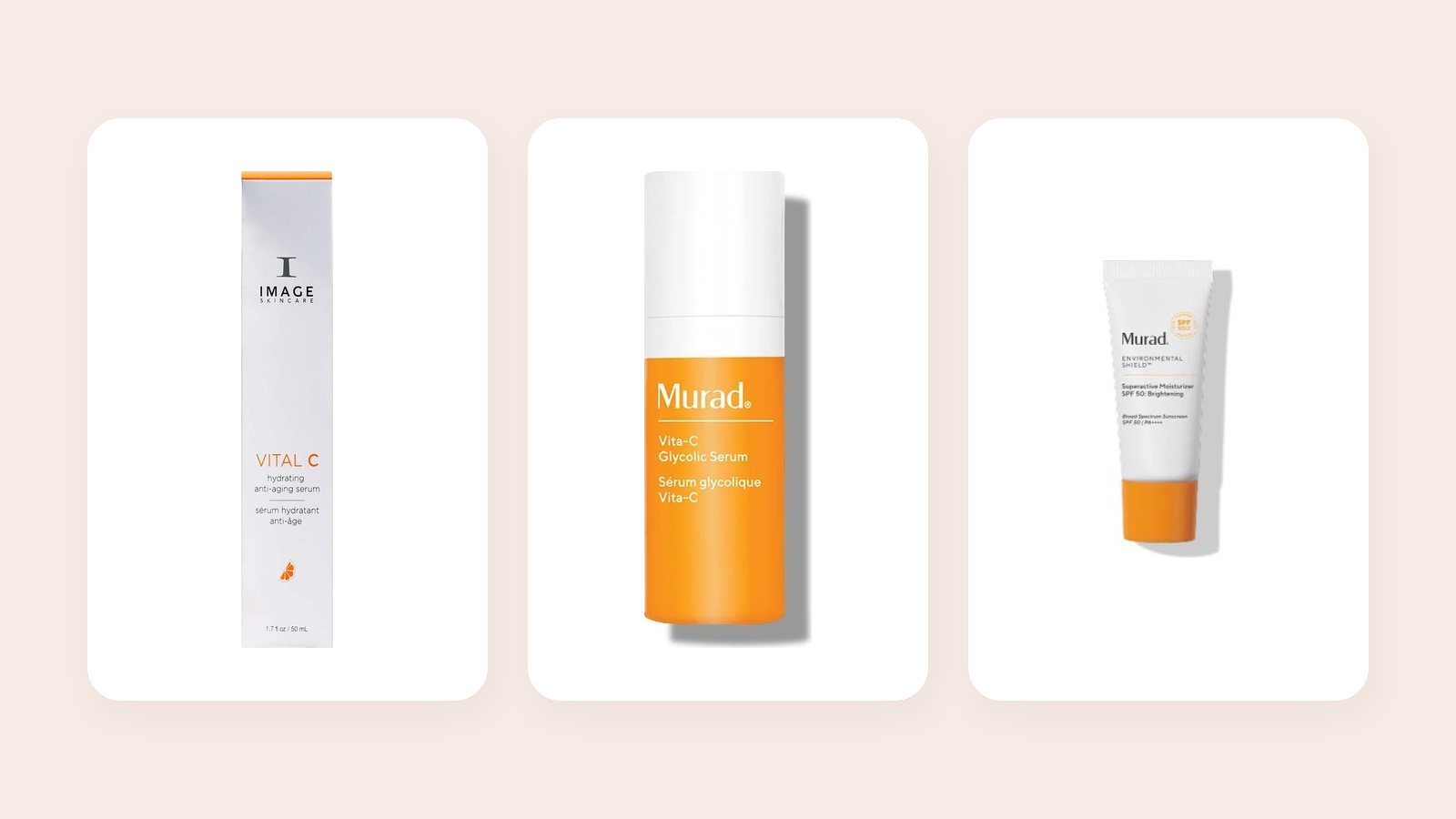
- IMAGE Skincare VITAL C Hydrating Anti-Aging Serum: IMAGE says it combines four forms of vitamin C with hyaluronic acid and has a citrus scent. Its directions call for 1 to 2 pumps on clean, dry skin, morning and evening, with SPF in the morning.
- Murad Environmental Shield Vita-C Glycolic Serum (travel size): vitamin C with glycolic acid. Murad says to use it morning and night after cleansing, follow with moisturizer and wear sunscreen by day, and that it’s formulated without fragrance.
- Murad Environmental Shield Essential-C Cleanser (travel size): a foaming gel cleanser with vitamins A, C and E, per Murad, which suggests following it with Vita-C Glycolic Serum.
- IMAGE Skincare VITAL C Hydrating Enzyme Masque: IMAGE says it pairs two forms of vitamin C with pineapple and papaya fruit enzymes, and directs 10 to 20 minutes on cleansed skin, 1 to 3 times a week, then a lukewarm rinse.
- Murad Environmental Shield Superactive Moisturizer SPF 50: Brightening (travel size): Broad Spectrum SPF 50, per its Drug Facts, which say to reapply at least every 2 hours and to use a water-resistant sunscreen when swimming or sweating. Murad says it contains stabilized vitamin C.
Call or text (949) 591-5304 with your list and we will confirm stock and pricing, then pick up at our Westminster store.
Related reading: how to wash your face the right way, the 48-hour hair dye patch test and dry, cracked hands from frequent hand washing.
FAQ
Does vitamin C serum go on before or after moisturizer?
Before. IMAGE says to let the serum absorb, then moisturize. Sunscreen goes last in the morning (AAD, Cleveland Clinic).
Can I use vitamin C serum at night?
If your product’s directions allow it. IMAGE and Murad direct morning and evening use, though dermatologists quoted by the AAD and Cleveland Clinic favor mornings.
Is it OK to use vitamin C serum that turned brown?
It has likely oxidized and lost strength. IMAGE says to throw it out.
Can I use vitamin C and retinol together?
Use them at different times: vitamin C in the morning and retinol at night, as an AAD article and IMAGE suggest.
Sources
- American Academy of Dermatology: Dermatologist-recommended skin care for your 20s (2023), How to fade dark spots in darker skin tones (2025), How to select anti-aging skin care products, How to test skin care products (2021), Do facial masks work? (2026), 10 skin care secrets for healthier-looking skin (2024) and A dermatologist’s guide to skincare from growing up to glowing up (news release, 2025)
- Cleveland Clinic: What Can Vitamin C Do for Your Skin? (2022), How To Order Your Skin Care Routine (2025), Benefits of Ferulic Acid (2024) and Popular Skin Care Ingredients Explained (2022)
- Reviews on PubMed Central (NIH): Al-Niaimi and Chiang, Topical Vitamin C and the Skin (2017); Telang, Vitamin C in dermatology (2013); Pullar and colleagues, The Roles of Vitamin C in Skin Health (2017); Yin and colleagues, Chemical Stability of Ascorbic Acid Integrated into Commercial Products (2022); Boo, Ascorbic Acid (Vitamin C) as a Cosmeceutical (2022)
- FDA: Alpha Hydroxy Acids (2022) and Shelf Life and Expiration Dating of Cosmetics (2022); DailyMed (NIH): Murad Superactive Moisturizer SPF 50: Brightening label (2025)
This is general information, not medical advice. Follow each product’s directions and the Drug Facts label on sunscreens, stop using anything that irritates your skin, and see a board-certified dermatologist about dark spots that don’t fade or any spot that changes.