

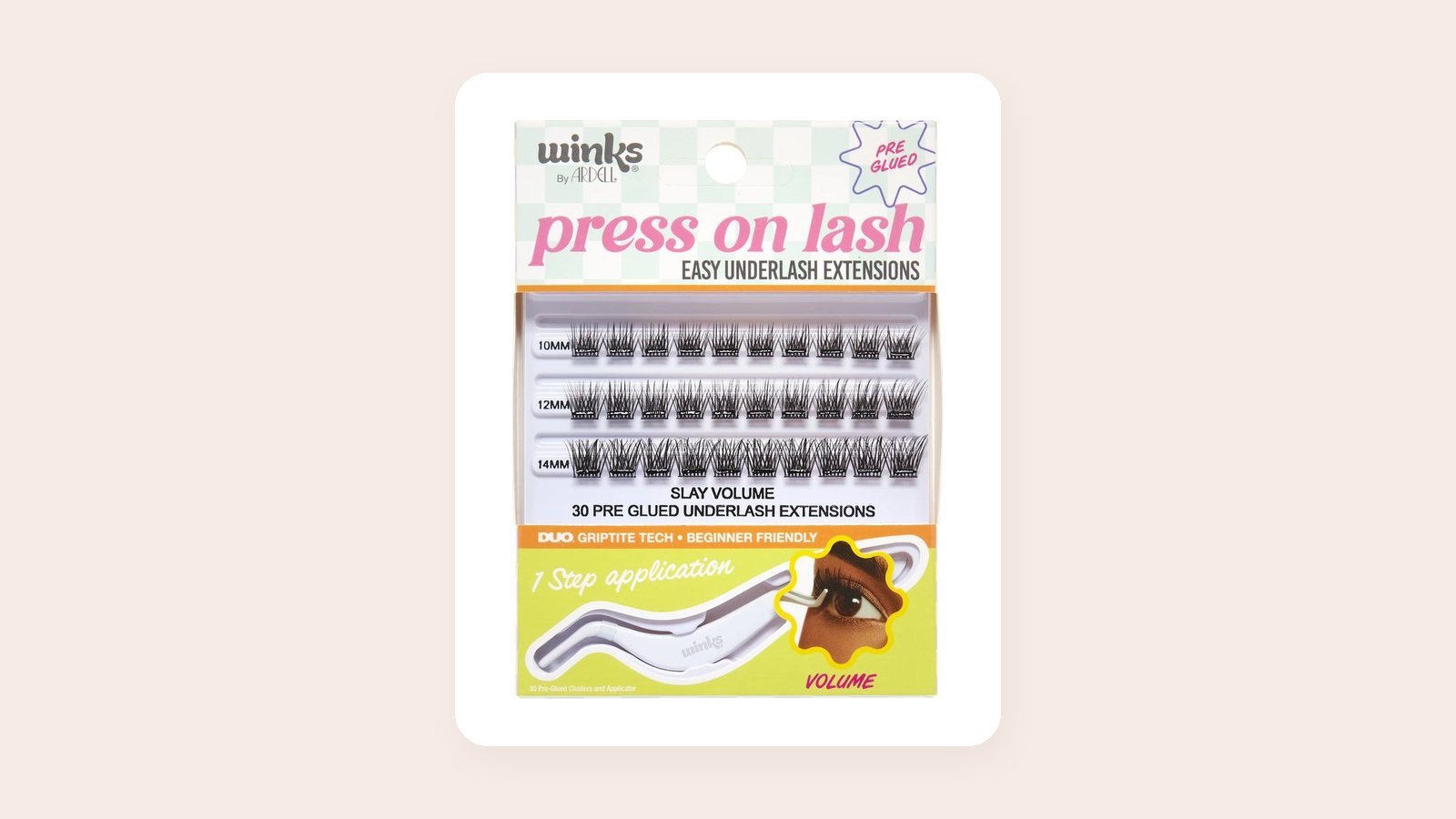
To apply press-on lashes, start with clean lashes, lift a pre-glued cluster off the tray with the applicator, set it under your natural lashes away from the waterline, and press it into your lashes with the applicator, as Ardell’s Winks directions describe. To remove them, lift each cluster off gently with your fingers, starting at the band, and never yank. The FDA and eye doctors add a few rules: clean hands, no sharing, no nail glue, and knowing when to stop.
Key takeaways
- Underlash clusters come pre-glued and go under your natural lashes; Ardell says no extra adhesive is needed.
- Wash your hands, keep the applicator clean, and never share eye cosmetics (FDA).
- Remove gently, starting at the band. The American Academy of Ophthalmology (AAO) warns that tugging can break lashes and damage the follicle.
- Never use nail glue or super glue on lashes. Poison Control says never to substitute a general-purpose glue for eyelash glue.
- Stop at the first sign of pain, itching, redness or swelling. The AAO says to see an ophthalmologist right away for any discomfort.
What are press-on underlash clusters?
They are small groups of false lashes on a thin band that already carries adhesive. Ardell’s Winks Press On kit, for example, holds 30 pre-glued clusters in 10, 12 and 14 mm lengths plus an applicator. Ardell calls them one-step extensions that need no extra glue, and says placing them under the natural lashes keeps the bands hidden.
They sit between two older options:
- Strip lashes attach above the natural lashes with a temporary adhesive, Poison Control explains.
- Salon extensions are glued to each natural lash with a semi-permanent glue, typically a cyanoacrylate (Poison Control), usually by a technician using tweezers (AAO). They last for weeks: three to four, says the AAO; six to eight, says Poison Control.
The FDA treats false lashes, lash extensions and their adhesives as cosmetics that must meet cosmetic safety and labeling requirements. It also notes that eyelids are delicate, so an allergy, irritation or injury there is especially troublesome, and says to check a lash adhesive’s ingredients before use. Ardell lists the Winks ingredients on its product page.
How to apply press-on lashes, step by step
Before you start:
- Wash your hands (FDA) and make sure your face and eyelids are clean (AAO).
- Clean the applicator. The FDA says any instrument you put near the eye should be clean.
- If you wear contacts, put them in first, as Johns Hopkins Medicine advises for makeup.
- Sit still at a mirror. The FDA and AAO both say never to apply eye cosmetics in a moving vehicle, and the AAO notes that applying lashes with tweezers puts a sharp object very close to the eye.
Then follow Ardell’s four steps:
- Start with clean lashes.
- Use the applicator to pull a cluster gently off the tray. The package directions add: avoid touching the adhesive band.
- Place the cluster under your natural lashes, away from the waterline. Start at the outer corner and work inward. Ardell says the three lengths let you customize the look to your eye shape.
- Use the applicator to seal the cluster to your natural lashes. Ardell says the applicator clamps the lashes together.
Keeping clusters away from the waterline fits the AAO’s general rule for eye products: apply them outside the lash line, away from the eye, so they don’t block the oil glands along the lid. The AAO also warns that glued or magnetic lashes can irritate eyelid skin, or dip into the eye and scratch the cornea, if they aren’t applied well.
Do a trial run on a quiet day. Cleveland Clinic’s ophthalmologist advises against a first try right before a big event, and the AAO suggests adding only one new eye product at a time if you react to products easily.
How long can you wear press-on lashes?
Ardell’s Winks directions don’t give a wear time. Here is what other sources say:
- Sleep: Ardell’s general lash FAQ says its lashes can be slept in; the Winks directions don’t address it. The AAO says to remove all eye makeup before sleep, and Cleveland Clinic’s ophthalmologist says to remove eye makeup every night.
- How often: the AAO suggests wearing false lashes for special occasions only, applied by a professional. Cleveland Clinic’s ophthalmologist also suggests giving your lashes a break for a few months after a big event.
- Why it matters: Cleveland Clinic explains that the weight of false lashes can pull on natural lashes and cause traction alopecia, hair loss from pulling, and that lash glue can trigger an allergic reaction that makes lashes fall out.
Where the sources differ, the cautious choice is the AAO’s: take the clusters off before bed.
How to remove press-on lashes without losing your own
Ardell’s removal step is short: use your fingers to lift each cluster off gently, starting with the band. A few more rules help:
- Go slowly. The AAO says rubbing, tugging or pulling can break natural lashes and even permanently damage the lash follicle.
- Loosen a stubborn cluster first. For temporary lashes, Poison Control suggests dabbing the adhesive with warm water, eyelash remover or eye makeup remover. Cleveland Clinic’s ophthalmologist recommends a gentle, fragrance-free eye makeup remover or micellar water, and the AAO says petroleum jelly helps makeup slide off without tugging.
- Keep remover out of your eyes and rinse it off your lids afterward (AAO).
- No acetone. Poison Control says acetone should not be used around the face or eyes.
- Expect a few loose lashes. Ardell’s FAQ says losing a few lashes during removal can happen because lashes shed naturally, and the AAO says losing one to five lashes a day is normal.
Never use nail glue or super glue on your lashes
Salon extension glue is usually a cyanoacrylate, the adhesive in Super Glue, but Poison Control says never to substitute a general-purpose glue for eyelash glue. It warns that super glue can seal eyelids together and, in the eye, cause pain, lash loss and corneal abrasions. Nail glue is a cyanoacrylate too, per makers’ safety data sheets; see our nail glue safety guide. The FDA and AAO both say not to use any cosmetic near your eyes unless it’s made for that use. Winks clusters come pre-glued, so if one won’t hold, take it off rather than adding a glue that isn’t meant for the eye area.
If glue gets in an eye, Poison Control says to rinse it with water for 15 minutes and not to force stuck lids open; the adhesive will eventually release. Call Poison Control at 1-800-222-1222, and get the eye checked if pain persists. Keep lash adhesives away from children and pets.
Hygiene, contact lenses and when to skip lashes
- Don’t share lashes or eye makeup, even with family (FDA, AAO).
- Skip them during an eye infection or when the skin around the eye is inflamed, and throw away the eye cosmetics you were using when the infection started (FDA). The AAO says to wait until the infection is gone.
- After eye surgery, wait until your ophthalmologist says eye makeup is safe (AAO).
- Reuse: the Winks directions don’t say whether a cluster can be worn twice. Ardell’s general FAQ describes cleaning and re-wearing lashes but doesn’t mention pre-glued clusters.
- Contact lenses: Ardell’s general lash FAQ says its lashes are safe for contact lens wearers. Johns Hopkins Medicine says to wash your hands before handling lenses, keep false eyelash glue away from them because it can damage lenses, and skip cosmetics when your eyes are red, swollen or infected.
When to stop and see an eye doctor
The FDA says to stop using an eye cosmetic right away if it causes irritation, and to see a doctor if the irritation persists. The AAO says an allergic reaction to lash glue can cause pain, itching, redness and swelling, and may briefly affect vision. With salon extensions, it adds, don’t try to remove them or treat a reaction yourself; see an ophthalmologist. Ardell’s FAQ also names allergy to the adhesive or lash fibers as a possible cause of swollen eyes after removal, and tells you to consult a physician.
Compiled from the FDA, the American Academy of Ophthalmology and Poison Control.
- Pain, itching, redness or swelling of the eye or lid
- A feeling that something is stuck in the eye, or tearing
- Blurry vision, sensitivity to light or any vision loss
- Irritation that continues after the lashes come off
- Lash loss on both lids, or with eyebrow or scalp hair loss
Severe pain or trouble seeing: go to the emergency room. Glue in the eye: rinse with water for 15 minutes and call Poison Control, 1-800-222-1222.
Report a bad reaction, too. The FDA says to stop using the product and contact your health care provider first, then report it through the FDA’s MedWatch online form or by calling 1-888-SAFEFOOD (1-888-723-3366), option 4.
At OBB
- Ardell Winks Press On Lash, Easy Underlash Extensions (Slay Volume): 30 pre-glued lash clusters in 10, 12 and 14 mm with an applicator, applied under the natural lash, according to Ardell.
Call or text (949) 591-5304 with your list and we will confirm stock and pricing, then pick up at our Westminster store.
Related reading: Nail Glue Safety, Hair Dye Allergy Test: 48-Hour Patch Test and Gel Nail Allergy and HEMA.
FAQ
Can you sleep in press-on lashes?
Ardell’s general lash FAQ says yes, but the Winks directions don’t say. The AAO advises removing all eye makeup before sleep, which is the cautious choice.
Can you reuse press-on lash clusters?
The Winks directions don’t say. Never share them, and throw away any you wore when an eye infection started, as the FDA advises for eye cosmetics.
Can you wear press-on lashes with contacts?
Ardell’s general lash FAQ says yes. Johns Hopkins Medicine advises putting lenses in before makeup and keeping false eyelash glue away from them.
Can I use nail glue if a cluster falls off?
No. Poison Control says never to substitute a general-purpose glue for eyelash glue, and the FDA says not to use any cosmetic near the eyes unless it’s made for that use.
What if a lash gets in my eye?
Don’t rub it. The AAO’s first-aid advice is to blink, rinse with clean water or saline, and not to touch the eye with fingers or swabs. See an ophthalmologist right away for pain, blurry vision or light sensitivity.
How many lashes is it normal to lose?
The AAO says one to five a day. Consult a doctor right away if you’re losing lashes on both lids, or eyebrow or scalp hair too.
Sources
- Ardell, Winks Press On 30 pc Volume + Applicator and Lash FAQs; Ulta Beauty, Winks Press On listing with package directions
- FDA, Eye Cosmetic Safety and How to Report a Cosmetic Product Related Complaint
- American Academy of Ophthalmology, Eyelash Extension Facts and Safety, How To Use Cosmetics Safely Around Your Eyes, Why Are My Eyelashes Falling Out? and How to Heal a Scratched Eye
- Poison Control, Is eyelash glue toxic? and Is super glue toxic?
- Cleveland Clinic, Why Are My Eyelashes Falling Out?; Johns Hopkins Medicine, Cosmetic Safety for Contact Lens Wearers
- Nail glue safety data sheets: V Beauty Pure Nail Glue (2025) and KDS Nail Glue (2014)
This is general information, not medical advice. Follow the directions on your lash package first. If you have eye pain, a change in vision or irritation that doesn’t clear up, see an eye doctor; for severe pain or trouble seeing, go to the emergency room. For glue in the eye, rinse with water and call Poison Control at 1-800-222-1222.