

Contents
ToggleIn the professional nail industry, your reputation is built on more than just skill or creativity — it’s built on safety, cleanliness, and consistency.
Clients today are more aware than ever of hygiene standards, and they expect salons to deliver not only beautiful results but also a sanitary, worry-free experience. That’s why every salon owner and technician must understand — and consistently practice — proper tool sanitation.
At OBB Nails, we supply professional-grade tools and bulk sanitation products to help salons meet (and exceed) state board hygiene standards. Here’s a complete guide to keeping your nail tools spotless, safe, and compliant — the professional way.
1. Why Proper Sanitation Is a Salon’s Foundation
Clean tools aren’t just a technical requirement — they’re a trust signal. When clients see a technician use freshly sanitized tools, their confidence in your salon immediately increases.
Failing to maintain proper sanitation, however, can have serious consequences:
Risk of fungal, bacterial, or viral infections.
Negative online reviews or lost clientele.
Failed health inspections or fines.
Damage to your brand’s reputation.
Professional sanitation protects not just your clients, but also your business.
2. Sanitation, Disinfection, and Sterilization: Know the Difference
To stay compliant, it’s important to know what each term means and when to use it:
|
Process |
Purpose |
Method |
|---|---|---|
|
Cleaning |
Removes dirt, debris, and visible residue. |
Soap, water, brush. |
|
Disinfection |
Kills most microorganisms on non-porous surfaces. |
EPA-registered disinfectant (bactericidal, fungicidal, virucidal), used per the label. |
|
Sterilization |
Eliminates all microorganisms, including spores. |
FDA-registered autoclave or dry-heat sterilizer. |
Most state boards in the U.S. require that salons:
Clean tools before disinfecting.
Use EPA-registered solutions (like Barbicide).
Store disinfected tools in a clean, covered container labeled “Clean” or “Disinfected”.
Tools that can’t be disinfected (buffers, emery boards, pumice, wooden sticks) are single-use only and must be discarded right after each client. California’s exact rules are in 16 CCR §§ 979–981; see our California pedicure spa cleaning requirements guide.
3. The 3-Step Salon Sanitation System
At OBB Nails, we recommend following a “Clean → Disinfect → Store” system for all professional nail tools.
Step 1: Clean Thoroughly
Before any chemical disinfection, remove physical debris.
Wash tools in warm water with soap or detergent.
Scrub hinges and edges with a small nail brush.
Rinse again and dry with a new, clean paper towel.
This prevents organic material from reducing the effectiveness of disinfectants.
Step 2: Disinfect or Sterilize
Depending on the tool’s material:
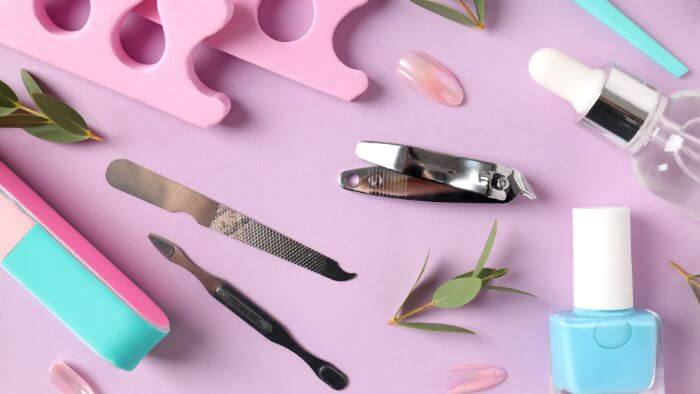
For Metal Tools (Clippers, Pushers, Nippers):
Fully immerse tools in an EPA-registered disinfectant labeled bactericidal, fungicidal and virucidal, for the full contact time on the label. Use gloves or tongs.
Or sterilize them in an FDA-registered autoclave or dry-heat sterilizer, with a chemical indicator on each package; tools stay in the sealed, labeled package until use (16 CCR § 982).
Remove with gloves or tongs and let dry before storing.
💡 Tip: Always label and track your sterilization cycles for inspection compliance.
For Non-Metal Tools (Files, Buffers, Wooden Sticks):
Single-use only. Discard immediately after each client.
Don’t spray and reuse buffers or files: porous items go in the trash after one client, even if stamped “disinfectable” (California Board bulletin).
Keeping new tools readily available in bulk ensures smooth service without compromising hygiene.
Step 3: Store Safely
Once tools are disinfected:
Place them in a clean, covered container labeled “Clean” or “Disinfected”, never in a pouch or holder that can’t itself be disinfected.
Keep used tools in a separate container labeled “Dirty”, “Soiled” or “Contaminated”.
Never mix clean and used tools in the same tray or drawer.
Proper storage is often the most overlooked part of salon sanitation — yet it’s what keeps tools hygienic until their next use.
4. Frequency of Sanitation in a Professional Setting
|
Tool Type |
Cleaning Frequency |
Replacement |
|---|---|---|
|
Metal tools |
After every client |
Replace if dull or rusted |
|
Buffers and files |
Single-use (can’t be disinfected) |
Discard after each client |
|
Brushes |
After each use |
Every 1–2 months |
|
Towels and table covers |
Fresh for every client; used ones go in a closed container |
Launder before reuse (commercial laundry, or 160°F+ water for 25 min) |
A clean salon should always have enough backup tools on hand to rotate — which is where wholesale ordering makes operations both easier and more affordable.
5. Wholesale Advantages: Keeping Your Salon Fully Stocked
Professional sanitation requires consistent supplies: disinfectants, alcohol, disposable wipes, buffers, gloves, and storage containers. Ordering these items in bulk ensures:
Lower unit costs for everyday essentials.
No downtime due to stock shortages.
Consistency in quality across every technician’s station.
At OBB Nails, we supply salons with wholesale packs of:
Nail files and buffers (various grits).
Disposable spa liners and gloves.
Disinfection trays and cleaning brushes.
Storage containers labeled for clean/used tools.
Bulk ordering means your team never has to cut corners — every client gets fresh, clean equipment every time.
6. What Happens If You Don’t Sanitize Properly?
Salons that overlook sanitation put everyone at risk — and the consequences can be costly:
Infections: Fungal spores and bacteria can spread fast.
Lost clientele: One bad hygiene experience often results in negative reviews.
Health citations: Inspectors can shut down operations for violations.
Reduced staff morale: Working in a clean environment motivates technicians and builds professionalism.
By following sanitation best practices, you prevent all of the above and elevate your salon’s reputation.
7. Beyond Tools: Hygiene Essentials Every Salon Should Maintain
Clean tools are only part of the picture. A truly hygienic salon should also include:
Disposable gloves for technicians.
Face masks or shields during close services.
Hand sanitizers available for clients and staff.
Disposable spa liners for pedicures.
Ventilation systems or dust collectors for acrylic and filing work.
Each element reinforces your salon’s reputation as a safe, modern environment.
8. Staff Training: Consistency Is Everything
Even the best supplies can’t guarantee safety without proper use. Regular training ensures all technicians understand and apply the same cleaning process:
Initial training when onboarding new staff.
Monthly refreshers for all employees.
Visual checklists posted at each station.
Technicians should always know:
How long to soak tools.
Which solutions to use for different materials.
How to label, store, and track sanitized tools.
A salon that trains consistently delivers consistent quality — and builds client trust faster.
9. Turning Sanitation into a Selling Point
Cleanliness doesn’t have to be hidden behind the scenes — use it as a marketing strength.
Here’s how successful salons highlight their hygiene standards:
Add a “Hygiene Guarantee” badge on your menu or website.
Display sanitation certificates at the front desk.
Open new files and buffers in front of clients, and take metal tools from the covered “Disinfected” container.
Post “behind the scenes” cleaning reels on Instagram or TikTok.
Clients love transparency — and seeing your commitment to safety makes them more loyal.
10. OBB Nails: Your Wholesale Partner for Hygiene Excellence
At OBB Nails, we understand that safe salons are successful salons. That’s why we supply:
Professional-grade tools designed for repeated sanitation cycles.
Bulk hygiene products including alcohol, wipes, gloves, and disposable liners.
Custom private-label options for multi-location salons and distributors.
Our goal is to make sanitation simple, affordable, and fully compliant — so you can focus on what you do best: creating beautiful nails.
11. Setting a New Hygiene Standard in the Industry
In 2025, the most trusted salons will be those that treat hygiene as a core part of their service — not just a regulatory checkbox.
Clients are becoming more educated about health and safety. They’ll remember the salon that opens new files and buffers in front of them and takes metal tools from a covered, labeled container — and they’ll recommend you for it.
12. Final Thoughts
Sanitation isn’t just a backroom process — it’s the heartbeat of every professional nail salon.
When tools are clean, clients feel safe. When clients feel safe, your salon thrives.
By maintaining consistent hygiene practices and partnering with trusted suppliers like OBB Nails, you protect your team, your clients, and your brand reputation.
Because in this industry, clean tools build beautiful trust.